
Google Search is changing rapidly. Instead of simply typing a few keywords, users can now ask detailed questions, have conversations, ask follow-up questions, use images or voice, and explore complex topics through AI-powered search experiences.
One of the biggest developments is Google AI Mode.
AI Mode is changing how people discover information—and that means SEO is changing too. But this does not mean traditional SEO is dead. In fact, Google says that the same foundational SEO practices remain relevant for AI features such as AI Mode and AI Overviews. Websites still need to be crawlable, indexable, useful, trustworthy and technically sound.
So, what exactly changes for SEO in 2026?
Let’s explore.
What Is Google AI Mode?
Google AI Mode is an AI-powered search experience designed to handle more complex and conversational searches.
Unlike a traditional search where users might enter:
“best SEO agency Pune”
A user could ask:
“What should a small business in Pune look for when choosing an SEO agency, and how can I compare agencies based on services, experience and results?”
AI Mode can interpret the broader question, break it into related searches and provide an AI-generated response with links to relevant websites.
Google describes this process as query fan-out, where a complex question can be broken into multiple related searches to explore different aspects of a topic.
AI Mode was introduced in India in 2025 and has continued to expand. Google has also added more conversational, visual and multilingual capabilities to AI-powered Search.
By 2026, AI-powered search is therefore becoming an important part of the SEO landscape.
How AI Mode Is Changing SEO in 2026
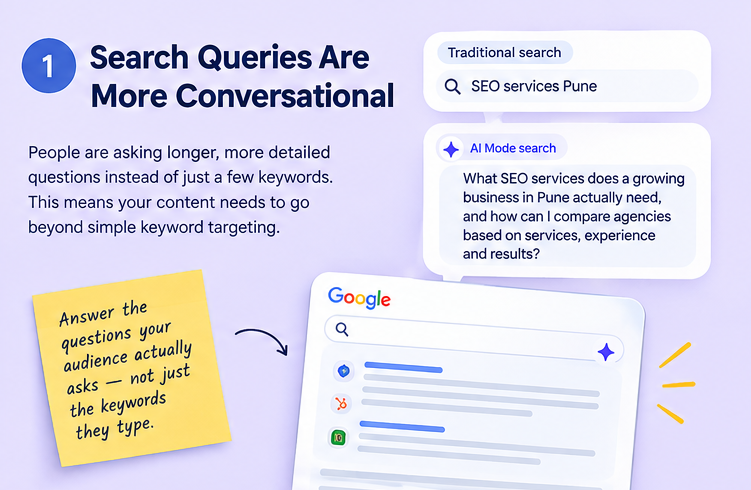
1. Search Queries Are Becoming More Conversational
Traditional SEO has historically focused heavily on keywords.
For example:
Traditional search:
“SEO services Pune”
Conversational search:
“What SEO services does a growing business in Pune actually need?”
The second query contains more context and user intent.
Google has reported that people using AI Mode are asking longer and more complex questions than traditional searches.
What does this mean for SEO?
Instead of creating content around only short keywords, businesses should understand the questions their audience actually asks.
Your content should naturally answer:
- What?
- Why?
- How?
- When?
- Which?
- How much?
- What are the alternatives?
- What problems can occur?
- What should someone do next?
This doesn’t mean stuffing every possible question into a page.
It means creating complete, useful resources that satisfy search intent.
2. Search Intent Matters More Than Exact-Match Keywords
AI-powered Search can understand relationships between concepts, questions and topics.
That makes search intent even more important.
For example, someone searching for:
“WordPress website slow”
could actually be looking for:
- reasons a WordPress site is slow
- how to test website speed
- how to optimize images
- how to reduce plugins
- how to improve Core Web Vitals
- how to improve hosting performance
A strong SEO page should address the underlying problem rather than simply repeating the phrase “WordPress website slow” dozens of times.
In 2026, SEO content should focus on:
Keyword → Topic → Intent → Problem → Solution
This creates content that is useful to both users and search systems.
3. Topical Authority Becomes More Important
AI Mode can explore multiple related aspects of a question.
That creates an opportunity for websites with strong topical coverage.
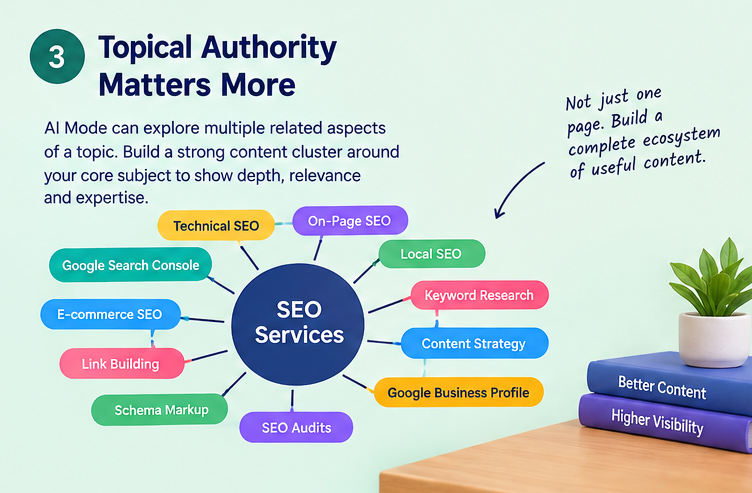
Imagine a website wants to rank for SEO services.
Instead of publishing one page called:
“SEO Services”
the website could build useful supporting content around:
- Technical SEO
- On-page SEO
- Local SEO
- Keyword research
- Google Search Console
- Website architecture
- Internal linking
- Schema markup
- SEO content strategy
- Google Business Profile
- SEO audits
- E-commerce SEO
- SEO reporting
These pages can be connected through internal links and organized into a clear website structure.
The goal is not to publish hundreds of low-quality articles.
The goal is to demonstrate depth, relevance and expertise around a subject.
Google’s current guidance specifically emphasizes valuable, unique and non-commodity content for generative AI search experiences.
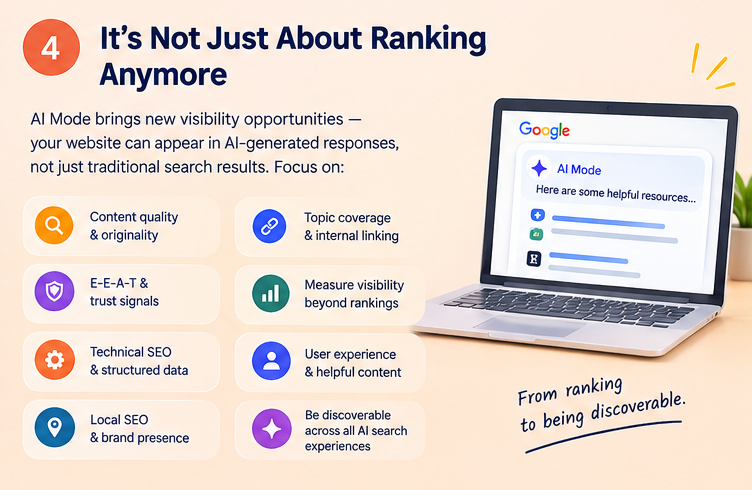
4. Being “Rank #1” Is No Longer the Only SEO Goal
Traditional SEO reporting often focuses on:
“Where does my page rank?”
But AI-powered Search introduces additional visibility opportunities.
Your website may appear as a supporting link within an AI-generated response even when the search experience doesn’t look like a traditional list of ten blue links.
Google’s AI features use links to help users explore information and discover websites.
This means SEO visibility increasingly involves questions such as:
- Is Google discovering my content?
- Is my content relevant to complex queries?
- Is my website being cited or linked?
- Which pages receive visibility in AI search experiences?
- Are users discovering my brand through informational searches?
- Are those users eventually visiting or converting?
SEO measurement therefore needs to move beyond a single ranking position.
5. Original Content Has More Value
AI can generate an enormous amount of generic content.
That makes genuinely useful information more valuable.
Google’s guidance for generative AI search emphasizes valuable, unique content rather than generic material that simply repeats information already available elsewhere.
For businesses, this means adding information that AI-generated generic articles may not have.
For example:
Instead of writing:
“SEO is important because it helps websites get traffic.”
A stronger article could include:
- original research
- first-hand experience
- examples
- screenshots
- case studies
- expert commentary
- original data
- processes
- real-world results
- practical recommendations
The question should be:
“What can my website provide that makes this page genuinely useful?”
6. E-E-A-T and Trust Signals Still Matter
AI-powered search does not eliminate the importance of trust.
Businesses should continue building clear signals around who created their content and why the information should be trusted.
Important elements can include:
- Author information
- Company information
- About page
- Contact information
- Credentials where relevant
- Original research
- References and sources
- Case studies
- Reviews and testimonials
- Clear business information
- Consistent brand information
For businesses operating locally, keeping information such as Google Business Profile details accurate is also important.
Google’s AI Search guidance recommends maintaining business information such as Business Profile and Merchant Center data where applicable.
7. Technical SEO Is Still the Foundation
One of the biggest misconceptions about AI SEO is that businesses need a completely new technical SEO system.
According to Google, there are no additional technical requirements specifically required to appear in AI Overviews or AI Mode.
A page still needs to meet Google’s normal requirements for Search, including being crawlable and indexable.
That means the fundamentals still matter:
Technical SEO Checklist
- Allow search engines to crawl important pages
- Ensure important pages are indexable
- Use a logical website structure
- Create useful internal links
- Maintain good page experience
- Make important content available as text
- Optimize images
- Use appropriate structured data
- Maintain accurate sitemap information
- Fix broken links and technical errors
- Monitor Google Search Console
AI search doesn’t replace technical SEO.
It builds on it.
8. Structured Data Still Helps Google Understand Your Website
There is a common misconception that businesses need to create special “AI schema” or an “AI file” to appear in AI Search.
Google’s current documentation says there is no special schema.org structured data or special AI markup required for AI Overviews or AI Mode.
However, structured data can still help Google understand eligible content and website entities when implemented correctly.
The important rule is simple:
Your structured data should accurately represent the visible content on your page.
Don’t add irrelevant or misleading schema simply because you want to appear in a particular search feature.
9. Content Structure Matters More
AI systems need to understand information efficiently.
That makes clear content structure increasingly useful.
Instead of creating a large block of text, organize information using:
Clear headings
Break long topics into logical sections.
Short paragraphs
Make content easier to read and understand.
Lists
Use bullet points and numbered steps where appropriate.
Direct answers
Answer important questions clearly before expanding on them.
Examples
Use real examples to explain complicated concepts.
Supporting media
Add useful images, screenshots, videos, charts or diagrams where they genuinely improve understanding.
Google’s guidance also recommends supporting textual content with high-quality images and videos when applicable.
10. Long-Tail and Question-Based Searches Become More Important
AI Mode encourages users to ask detailed questions.
That creates opportunities for businesses to target long-tail search intent.
For example, instead of focusing only on:
“Digital marketing agency Pune”
a business could also create useful resources around questions such as:
- How much does digital marketing cost for a small business in Pune?
- What services does a digital marketing agency provide?
- How long does SEO take to show results?
- How can a local business improve Google Maps visibility?
- What is the difference between SEO and Google Ads?
- How can I improve my website’s Core Web Vitals?
These questions can become blog articles, service-page sections, FAQs, guides and supporting resources.
The objective is not to create content for every possible keyword.
It is to cover the real information needs of your audience.
11. Local SEO Is Also Evolving
AI-powered search can make local discovery more conversational.
Instead of simply searching:
“digital marketing agency near me”
users may ask:
“Which digital marketing agencies can help a small business in Pune with SEO, Google Ads and social media?”
For local businesses, this makes accurate and consistent business information increasingly important.
Businesses should maintain:
- Google Business Profile
- Business name
- Address
- Phone number
- Website
- Business category
- Services
- Opening hours
- Reviews
- Photos
- Location-specific content
Local landing pages and genuinely useful local content can also help establish relevance.
12. Brand Visibility Matters More Than Ever
SEO traditionally focuses heavily on traffic.
But AI-powered search can introduce another valuable outcome:
Brand discovery.
A user might first encounter your business while researching a problem through an AI-powered search experience.
They may then:
- See your brand mentioned or linked.
- Visit your website.
- Search your brand name later.
- Explore your services.
- Read reviews.
- Contact your business.
This means SEO strategy increasingly needs to consider the entire search journey, rather than only the first click.
13. Don’t Replace SEO With “AI SEO”
Another important point from Google’s guidance is that businesses don’t need a completely separate optimization system to appear in AI features.
Google states that existing SEO best practices remain foundational for generative AI features.
You will see terms such as:
- AEO — Answer Engine Optimization
- GEO — Generative Engine Optimization
- AI SEO
- LLM Optimization
These terms can be useful for describing new search behaviors, but they shouldn’t lead businesses to abandon proven SEO fundamentals.
A better approach is:
Technical SEO + Helpful Content + Strong Brand + Search Intent + User Experience + Original Information
14. AI-Generated Content Needs Human Value
AI tools can make content creation faster.
But publishing large quantities of automatically generated pages without adding meaningful value can create SEO risks.
Google’s guidance says using generative AI to produce many pages without adding value may violate its spam policies around scaled content abuse.
AI can be useful for:
- Research
- Brainstorming
- Outlining
- Content organization
- Drafting
- Summarization
- Editing
But businesses should add human expertise, verification, originality and useful context.
The goal should not be:
“How many articles can we publish with AI?”
Instead:
“How much useful information can we create for our audience?”
How Should Businesses Adapt Their SEO Strategy in 2026?
A practical 2026 SEO strategy could look like this:
| SEO Area | 2026 Focus |
|---|---|
| Keywords | Search intent and conversational queries |
| Content | Helpful, original and comprehensive information |
| Technical SEO | Crawlability, indexability and performance |
| Internal Linking | Strong topic relationships |
| Local SEO | Accurate business information and local relevance |
| Content Quality | First-hand expertise and original insights |
| Structured Data | Accurate implementation where applicable |
| Multimedia | Useful images, video and visual explanations |
| Brand | Build recognition and trust |
| Analytics | Track visibility, traffic, engagement and conversions |
| AI Search | Monitor visibility within generative search experiences |
Google Search Console Is Becoming More Important
One of the most useful developments for SEO professionals in 2026 is Google’s expansion of Search Console reporting for generative AI features.
Google announced dedicated Search Console insights for visibility in generative AI features such as AI Overviews and AI Mode. Google said these reports were rolled out globally by August 31, 2026.
This gives SEO teams another way to understand how websites are appearing across Google’s evolving search experiences.
Instead of relying entirely on third-party tools, businesses should continue using first-party data from Google Search Console alongside their existing SEO analytics.
The Future of SEO: From Ranking to Being Discoverable
Google AI Mode doesn’t mean that SEO is disappearing.
It means that search itself is expanding.
Users are asking longer questions.
Search is becoming more conversational.
AI is helping users explore complex topics.
And websites can be discovered through more types of search experiences.
For businesses, the SEO mindset needs to evolve from:
“How do I rank for this keyword?”
to:
“How can my website become the most useful and trustworthy source for this topic?”
That shift can influence everything from keyword research and content strategy to website architecture, local SEO and conversion optimization.
The fundamentals remain important—but the definition of search visibility is becoming broader.
Final Thoughts
Google AI Mode is one of the biggest changes to search in the 2026 SEO landscape.
But businesses don’t need to abandon traditional SEO and chase every new AI optimization trend.
Google’s own guidance makes the direction relatively clear: strong SEO fundamentals still matter. Websites should be technically accessible, indexable, easy to navigate and built around helpful, reliable, people-first content.
The difference is that SEO now needs to account for a more conversational and exploratory search journey.
If your website consistently provides original information, clear answers, strong expertise, useful resources and a good user experience, you are building an SEO foundation that can adapt as Google Search continues to evolve.
Grow Your Online Presence With The Vanilla Theory
At The Vanilla Theory, we help businesses build stronger digital visibility through SEO, website development, Google Ads, social media marketing, branding, content strategy and performance marketing.
From improving technical SEO and website structure to developing content strategies designed around real search intent, our approach focuses on building sustainable digital growth.
Want to improve your website’s visibility in the evolving world of Google Search?
Explore our digital marketing and SEO services at The Vanilla Theory and build a search strategy designed for 2026 and beyond.


