
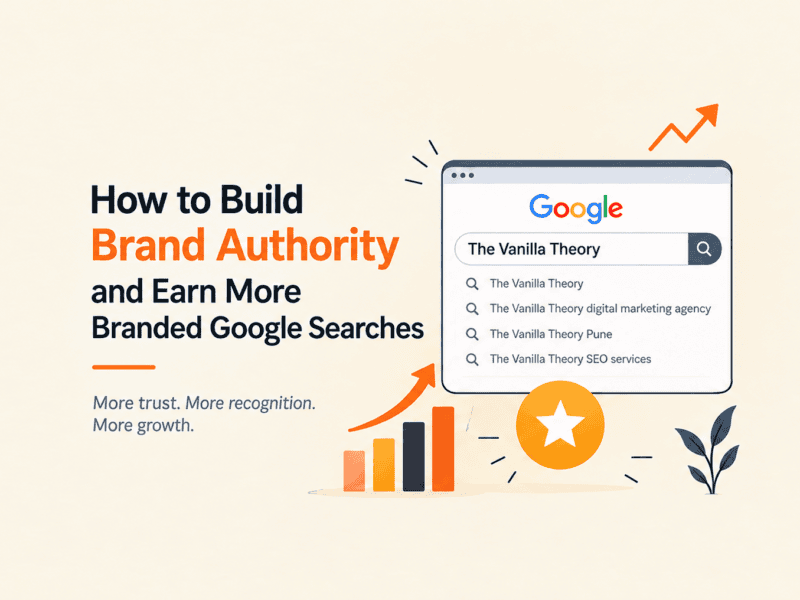
In today’s competitive digital landscape, ranking on Google is only one part of a successful SEO strategy. Businesses also need people to recognize their brand, trust their expertise, and actively search for them online. This is where brand authority becomes important.
When users search for your business by name rather than searching for a generic service, they demonstrate a higher level of brand awareness. These searches are known as branded Google searches, and they can be a valuable indicator of how well your brand is connecting with its audience.
For example, someone searching for “digital marketing agency in Pune” is looking for a service provider. Someone searching for “The Vanilla Theory digital marketing agency” already knows the brand or has encountered it before.
Building brand authority can help businesses attract more of these searches, strengthen customer trust, and create more opportunities for long-term growth.
In this guide, we will explore what brand authority means, why branded searches matter, and how businesses can increase brand recognition through SEO, content marketing, digital PR, and a consistent online presence.
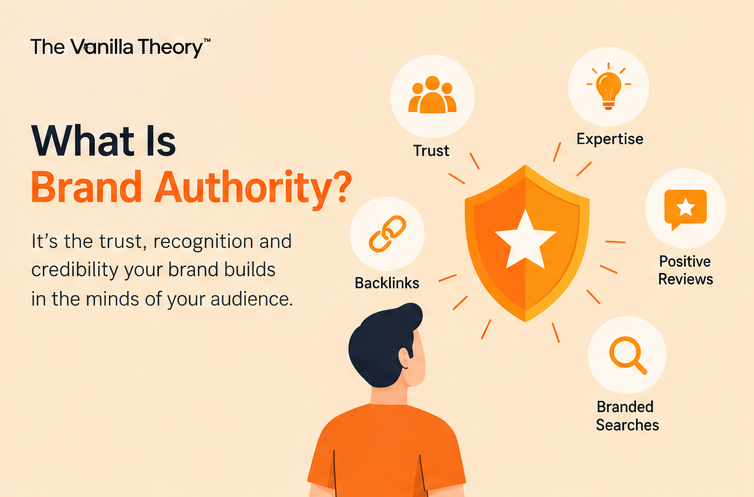
What Is Brand Authority in SEO?
Brand authority refers to the level of trust, recognition, and credibility a business establishes within its industry. A brand with strong authority is more likely to be recognized by its target audience as a reliable source of information, products, or services.
In SEO, brand authority is reflected through several signals, including:
- Consistent brand mentions across relevant websites and publications.
- High-quality content that demonstrates expertise.
- Positive customer reviews and testimonials.
- Relevant backlinks from trustworthy websites.
- Branded searches and direct website visits.
- Consistent business information across digital platforms.
- Recognition through social media, communities, and industry discussions.
Brand authority is not a single Google ranking factor that can be increased through one specific action. Instead, it develops through multiple signals that help people discover, recognize, and trust a business.
When your brand becomes familiar to your audience, people may be more likely to search for your business directly rather than relying entirely on generic search terms.
What Are Branded Google Searches?
Branded Google searches are searches that include a specific business name, brand name, product name, or other recognizable brand identifier.
For example, branded searches for The Vanilla Theory might include:
- The Vanilla Theory
- The Vanilla Theory digital marketing agency
- The Vanilla Theory Pune
- The Vanilla Theory SEO services
- The Vanilla Theory website development
These searches differ from non-branded searches, such as “best digital marketing agency in Pune” or “SEO services for small businesses.”
Non-branded searches often help businesses reach people who are discovering their services for the first time. Branded searches help businesses understand whether people are actively looking for their name or related information.
However, a branded search does not always indicate strong purchasing intent. Users may be looking for contact details, reading reviews, exploring services, or simply learning more about the business.
Why Do Branded Searches Matter?
Branded searches can provide useful insights into how your brand is performing online.
1. They indicate brand awareness
When people remember your brand name and search for it, your business has become recognizable to them.
2. They can attract more qualified visitors
Users searching for a specific company may already have some familiarity with its services, although their intent can vary.
3. They help you understand marketing performance
An increase in branded searches may coincide with successful campaigns, social media activity, PR coverage, or content distribution.
4. They support long-term business growth
A recognizable brand can make it easier for customers to return, explore additional services, and recommend your business to others.
Branded searches should be evaluated alongside conversions, enquiries, revenue, and other relevant performance metrics rather than treated as a standalone measure of SEO success.
1. Establish a Clear and Consistent Brand Identity
Brand authority begins with clarity. People should be able to understand who you are, what you offer, and why your business is different from competitors.
If your brand communicates different messages across your website, social media profiles, business listings, and marketing campaigns, it becomes harder for people to recognize and remember you.
Start by defining the essential elements of your brand:
- Brand positioning: What makes your business different?
- Target audience: Who do you want to reach?
- Core services: What problems do you solve?
- Brand messaging: What should customers associate with your business?
- Visual identity: Are your logo, colours, and design consistent?
- Brand voice: Does your communication reflect the same personality across channels?
For example, The Vanilla Theory can consistently communicate its expertise in SEO, website development, Google Ads, social media marketing, branding, and digital strategy.
Use similar descriptions and accurate business details across your website and relevant platforms. Consistency helps audiences connect different online touchpoints with the same business.
2. Create High-Quality Content That Demonstrates Expertise
Content marketing is one of the most effective ways to demonstrate your knowledge and build credibility within your industry.
Publishing content simply to target more keywords is not enough. Your content should answer real questions, solve problems, and offer useful insights that readers can apply.
Focus on creating content that reflects your expertise, such as:
- Detailed how-to guides.
- Industry insights and trend analysis.
- Case studies with measurable results.
- Practical checklists and tutorials.
- Expert opinions and original research.
- Frequently asked questions about your services.
- Comparisons that help readers make informed decisions.
For instance, a digital marketing agency could publish guides on improving website visibility, fixing indexing issues, building an effective SEO strategy, or measuring campaign performance.
A reader might initially discover your content through a non-branded Google search. If the article provides genuine value, they may remember your business and search for its name when they need professional assistance.
This creates a potential journey from content discovery to brand recognition and, eventually, a business enquiry.
Build Topic Clusters Around Your Expertise
Instead of publishing unrelated articles, organize your content around a few core topics.
For example, an SEO topic cluster could include:
- Complete SEO checklist.
- Technical SEO audit guide.
- Google indexing troubleshooting.
- Website architecture for SEO.
- Search impressions but no clicks.
- Google AI Mode and its impact on SEO.
Link related articles to one another and connect them to relevant service pages. This helps readers explore your expertise while giving search engines clearer context about the relationships between your website’s pages.
Most importantly, prioritize helpfulness, accuracy, originality, and a clear purpose for every article.
3. Build a Strong and Consistent Search Presence
Your website is not the only place where potential customers discover your business. They may encounter your brand through Google Business Profile, social networks, industry directories, review websites, and third-party publications.
A consistent search presence makes it easier for people to verify that your business is legitimate and understand what it offers.
To strengthen your presence:
- Keep your website’s About, Services, and Contact pages updated.
- Maintain accurate business information on relevant directories.
- Optimize your Google Business Profile if you serve local customers.
- Add recent, authentic business photos where appropriate.
- Encourage genuine customer reviews without offering incentives in exchange for positive ratings.
- Maintain active and consistent business profiles on relevant social platforms.
- Make your business name, services, and contact information easy to identify.
For a business targeting Pune, a well-maintained Google Business Profile can help people discover its local services, view reviews, and find directions or contact details.
Remember that creating profiles on every available platform is not necessary. Prioritize the channels your audience actually uses.
4. Earn Quality Backlinks and Relevant Brand Mentions
Backlinks are links from other websites that point to your website. Relevant, editorially earned backlinks can help search engines discover your content and may contribute to your site’s authority.
Brand mentions also matter from a marketing perspective because they expose your business to audiences beyond your own website. A mention does not always need to include a clickable link to create awareness.
Here are practical ways to earn relevant mentions:
Guest contributions: Share genuinely useful articles with reputable websites in your industry.
Digital PR: Offer expert commentary, original findings, or insights that journalists and publishers may find valuable.
Original research: Publish surveys, industry reports, or useful data that other websites may reference.
Industry collaborations: Participate in relevant podcasts, webinars, interviews, and professional events.
Customer stories: Collaborate with clients on case studies that explain the problem, solution, and measurable outcome.
Community participation: Answer relevant questions and contribute meaningful insights in professional communities.
Avoid buying large quantities of low-quality backlinks or creating artificial mentions solely to manipulate rankings. Focus on relevance, editorial quality, and genuine audience value.
As more people encounter your brand through trusted sources, they have additional opportunities to remember your name and visit your website.
5. Use Social Media to Increase Brand Recall
Social media can help your business remain visible between Google searches. Although social engagement does not directly translate into higher Google rankings, social platforms can distribute your content, introduce your brand to new audiences, and encourage people to search for you later.
A strong social media strategy should focus on repeated, recognizable, and useful communication rather than simply posting frequently.
Consider these approaches:
- Share practical tips related to your services.
- Repurpose blog posts into carousels, short videos, and infographics.
- Explain common industry problems and how to solve them.
- Showcase genuine project outcomes and client experiences.
- Share behind-the-scenes content that introduces your team.
- Publish original opinions about relevant industry developments.
- Use a consistent brand voice and recognizable visual identity.
For example, a blog about technical SEO could become a short video explaining a common indexing issue, a carousel showing the troubleshooting process, and a LinkedIn post discussing the lesson learned.
Each format reaches a different audience while reinforcing the same area of expertise.
The objective is to make your brand memorable enough that people recognize it when they encounter it again.
6. Optimize Your Website for Branded Searches
Earning more branded searches is only part of the process. Your website must also help people find accurate information when they search for your business.
Start with the following improvements:
Create a clear homepage title: Include your brand name and a concise description of your business where appropriate.
Write a useful About page: Explain your background, expertise, services, approach, and the people behind the business.
Use descriptive service pages: Give each major service a dedicated page with clear information about its benefits and scope.
Make contact information easy to find: Include accurate contact details and straightforward enquiry options.
Use consistent branding: Ensure your logo, business name, and messaging are recognizable throughout the site.
Implement appropriate structured data: Use relevant Schema.org markup, such as Organization or LocalBusiness where applicable, with accurate and visible information.
Maintain technical SEO: Check indexing, canonical tags, mobile usability, internal links, page speed, and broken URLs.
Monitor branded search results: Search for your brand name and common variations to understand what users see. Review your own website, business profiles, and relevant third-party pages.
Structured data can help search engines understand information about your business, but it does not guarantee a knowledge panel or special search result.
Similarly, using your brand name repeatedly across every page is unnecessary. Write naturally and focus on helping users recognize and navigate your business.
7. Strengthen Customer Trust With Reviews and Case Studies
Trust plays an important role in how people perceive a brand. Customers often look for evidence that a business can deliver what it promises before making an enquiry or purchase.
Reviews and case studies can provide that evidence when they are authentic, specific, and relevant.
To strengthen trust:
- Ask satisfied customers to share honest feedback.
- Respond professionally to reviews, including negative feedback.
- Publish case studies explaining the original challenge and the work performed.
- Include measurable outcomes when reliable data is available.
- Showcase relevant testimonials with permission.
- Explain your process, deliverables, and service expectations clearly.
- Keep portfolio examples and business information up to date.
For example, a digital marketing agency could document how it improved a website’s technical health, increased relevant organic traffic, or helped a business generate more qualified enquiries.
Avoid vague claims such as “We guarantee first-page rankings.” Specific explanations and verifiable results provide a stronger foundation for credibility.
When customers trust your expertise, they may be more likely to return directly to your website, recommend your business, or look up your brand by name.
8. Create Content That Gives People a Reason to Remember You
Publishing general information is useful, but content that offers a distinctive perspective can make your brand easier to remember.
Ask yourself: What can your business explain, demonstrate, or investigate that your audience will find particularly useful?
You can develop recognizable content through:
- Original frameworks or methodologies.
- Industry-specific guides.
- Unique case studies.
- Expert commentary on changing trends.
- Free tools, templates, and downloadable resources.
- Detailed troubleshooting tutorials.
- Data-backed experiments and research.
For example, rather than publishing another generic article about website speed, you could create a practical guide documenting how to identify and fix common WordPress performance problems.
A useful resource can continue attracting visitors long after publication. Readers may also share it with colleagues, reference it in discussions, or return to your website when they need similar guidance.
The goal is not to make every piece of content promotional. It is to consistently associate your brand with useful knowledge and reliable solutions.
9. Track Branded Searches in Google Search Console
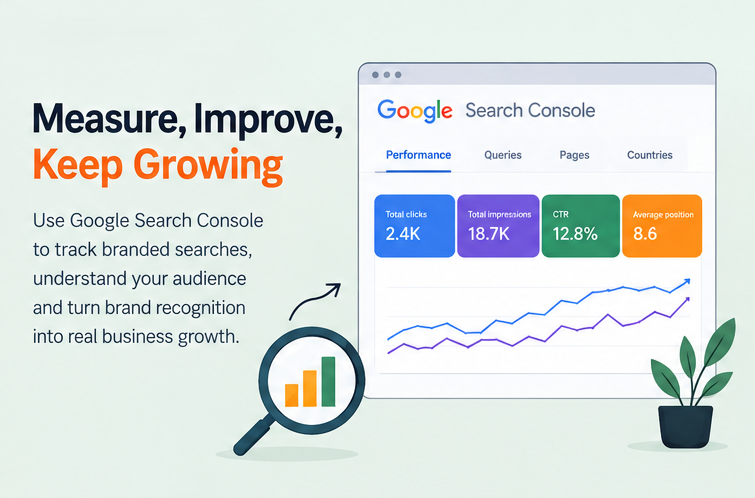
You cannot improve what you do not measure. Google Search Console provides useful data for understanding how people discover your website through Google Search.
To monitor branded search performance:
- Open Google Search Console and select your website property.
- Navigate to the Performance report and open Search results.
- Select a suitable date range, such as the last three months.
- Review total clicks, total impressions, average click-through rate, and average position.
- Open the Queries tab.
- Filter queries containing your brand name and relevant brand variations.
- Compare the results with an earlier period of similar length.
- Review which pages receive branded clicks and impressions.
For The Vanilla Theory, relevant queries might include “The Vanilla Theory,” “The Vanilla Theory Pune,” and other genuine variations of the business name.
Use query filters carefully. A filter for your exact brand name will not capture every possible variation, misspellings, or searches that mention your services without including the full business name.
Key Metrics to Monitor
Branded impressions: How often your website appeared in Google Search for queries containing your brand name.
Branded clicks: How many clicks those queries generated.
Branded click-through rate (CTR): The percentage of impressions that resulted in clicks.
Average position: Your website’s average ranking position for the selected queries.
Organic conversions: Enquiries, calls, form submissions, or other meaningful actions attributed to organic search where measurement is available.
Brand-related referral traffic: Visits that arrive through relevant external websites, tracked using analytics and referral data.
Google Search Console does not provide a complete measurement of total brand awareness. It reports activity for your website in Google Search, not every time someone searches for your brand across the internet.
Also, an increase in branded impressions does not automatically mean your brand has become more popular. Changes in rankings, search demand, and the number of indexed pages can affect the figures. Interpret the data alongside other marketing and business metrics.
10. Turn Brand Recognition Into Business Growth
More people searching for your brand can create opportunities, but the real objective is to turn recognition into meaningful business outcomes.
Make the next step clear for visitors who arrive on your website.
Depending on your business goals, this could mean:
- Requesting a consultation.
- Enquiring about a service.
- Booking a discovery call.
- Exploring relevant case studies.
- Downloading a useful resource.
- Contacting your team through an appropriate channel.
Use clear calls to action and remove unnecessary friction from the enquiry process. Ensure that service pages explain what customers can expect and provide enough information to make an informed decision.
Track enquiries and conversions alongside branded search activity. This helps you determine whether improved visibility is attracting the right audience and contributing to business goals.
Remember that brand building is a long-term process. Consistency, customer experience, useful content, and credible communication are more sustainable than short-term tactics designed to increase search volume artificially.

Common Mistakes to Avoid When Building Brand Authority
Even a well-planned SEO strategy can become less effective when it focuses on the wrong activities.
Avoid these common mistakes:
- Buying backlinks: Low-quality or manipulative link schemes can create SEO risks.
- Publishing content without a clear purpose: More articles do not automatically create more authority.
- Ignoring customer experience: Poor service and unanswered complaints can weaken trust.
- Inconsistent brand messaging: Different descriptions across platforms can confuse potential customers.
- Overusing your brand name: Repetitive keyword placement makes content less natural and useful.
- Relying only on social media followers: Followers alone do not demonstrate search visibility or business success.
- Chasing branded searches without conversions: Higher search volume is useful only when considered alongside audience quality and business outcomes.
- Expecting immediate results: Recognition develops through repeated exposure and positive experiences over time.
The most effective strategy combines technical SEO, relevant content, customer trust, consistent branding, and meaningful measurement.
Conclusion
Building brand authority and earning more branded Google searches requires more than optimizing a few website pages. It involves creating a brand people recognize, publishing content they find useful, demonstrating expertise, earning credible mentions, and delivering a consistent customer experience.
Start by clarifying your brand positioning, strengthening your website, publishing genuinely helpful content, and maintaining accurate information across relevant platforms. Support these activities with digital PR, authentic customer reviews, and consistent social media communication.
Then use Google Search Console and your analytics tools to understand whether more people are discovering and choosing your business.
For businesses investing in SEO, the long-term goal should not be simply to appear in more search results. It should be to become a recognizable, credible choice within the industry.
Want to strengthen your brand’s online visibility? The Vanilla Theory helps businesses build a stronger digital presence through SEO, website development, content strategy, and digital marketing. Explore our services to discover how a more consistent digital strategy can support your business growth.


