
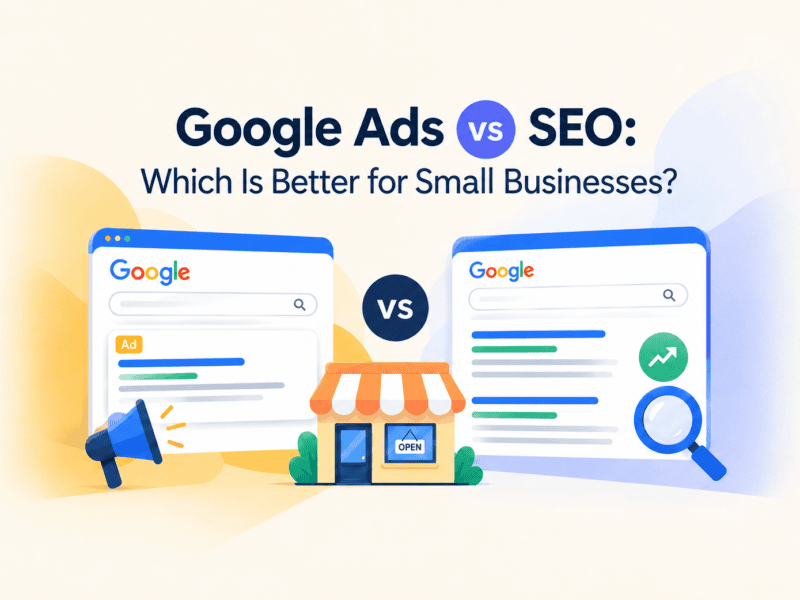
Google Ads vs SEO: Which is better for small businesses? Choosing the right digital marketing strategy can help small businesses attract potential customers, generate leads, and grow online. While Google Ads provides faster paid visibility, Search Engine Optimization (SEO) helps businesses build long-term organic visibility. Understanding their differences in cost, results, and benefits can help you choose the right strategy for your business.
When it comes to online visibility, two of the most effective digital marketing strategies are Google Ads and Search Engine Optimization (SEO). Both help businesses appear in Google search results, but they work differently, require different investments, and deliver results on different timelines.
So, which is better for small businesses: Google Ads or SEO?
The answer depends on your business goals, marketing budget, competition, and how quickly you want to generate leads. In this guide, we will compare Google Ads and SEO, explain their advantages and limitations, and help you decide which strategy is right for your business.
What Is Google Ads?
Google Ads is a paid online advertising platform that allows businesses to display advertisements across Google Search and other Google advertising networks.
With Google Search Ads, your business can appear near the top of search results when people search for products or services related to your offerings. You typically pay when someone clicks on your ad, depending on your campaign and bidding strategy.
For example, if you run a digital marketing agency in Pune, you could create a Google Ads campaign targeting searches such as “digital marketing agency in Pune” or “SEO services near me.”
This helps you reach potential customers who are actively looking for your services.
Benefits of Google Ads for Small Businesses
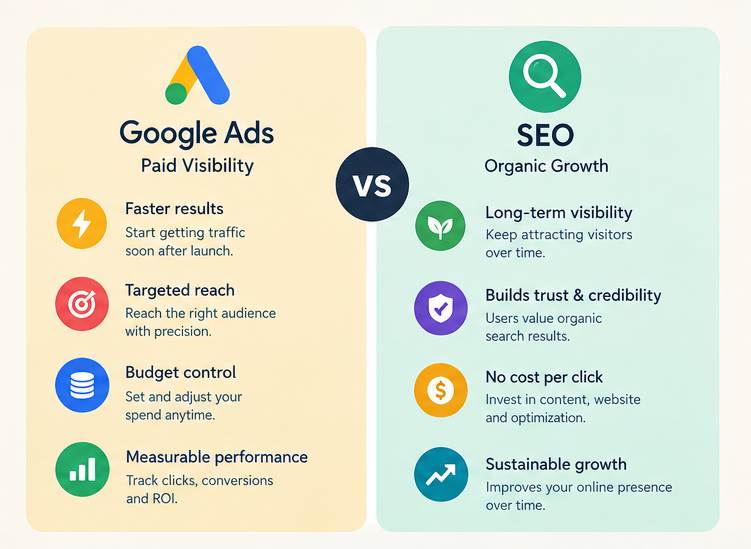
1. Faster visibility
Google Ads can start generating visibility soon after your campaign is approved and launched. It is useful when you need to promote a new service, launch an offer, or attract leads quickly.
2. Targeted audience reach
You can target relevant search terms, geographic areas, languages, and other available audience signals to reach potential customers.
3. Budget control
You can set campaign budgets, adjust bids, pause campaigns, and monitor advertising expenses. However, your actual cost per lead depends on competition, targeting, landing-page quality, and conversion rates.
4. Measurable performance
Google Ads provides data such as impressions, clicks, cost, and conversions when tracking is configured correctly. These insights help you evaluate which campaigns contribute to your business goals.
Limitations of Google Ads
- Ongoing advertising costs: You generally need to keep investing to maintain paid campaign visibility.
- Competitive bidding: Popular keywords can become expensive, especially in competitive industries.
- No guaranteed sales: Clicks do not automatically translate into leads or customers.
- Campaign management: Poor keyword selection, weak landing pages, or incorrect tracking can waste your budget.
Google Ads can be effective for businesses that need faster results, but success depends on strategic campaign management and a clear conversion goal.
What Is SEO?
Search Engine Optimization (SEO) is the process of improving your website so that search engines can discover, understand, and potentially rank its pages in relevant organic search results.
Unlike paid advertising, SEO does not require you to pay Google for every click from organic search. However, it does require investment in content creation, technical improvements, keyword research, website optimization, and ongoing maintenance.
For example, a small business offering website development can create useful content around website costs, website maintenance, WordPress troubleshooting, and choosing a web development company. These pages can attract people searching for relevant information and services.
Benefits of SEO for Small Businesses
1. Long-term organic visibility
Well-optimized pages can continue attracting relevant visitors over time. Rankings are not guaranteed, and results depend on competition, search intent, content quality, and other factors.
2. Reduced dependence on paid clicks
Organic search traffic does not incur a per-click advertising charge. You still need to account for the cost of producing content, maintaining your website, and carrying out SEO activities.
3. Builds trust and credibility
Users may discover your business through helpful articles, service pages, case studies, and relevant search results. High-quality content can demonstrate your expertise and help potential customers make informed decisions.
4. Supports local discovery
Local SEO helps businesses improve their visibility for relevant location-based searches. Optimizing your Google Business Profile, maintaining accurate business information, collecting genuine customer reviews, and creating useful local content can support local discovery.
5. Creates long-term business value
A well-structured website with useful content can attract visitors across multiple relevant search queries, helping your business build a stronger online presence over time.
Limitations of SEO
- Takes time: Meaningful organic growth often requires consistent work over several months, although timelines vary.
- Competitive rankings: Established competitors may have stronger websites, more useful content, and greater authority.
- Ongoing optimization: Search intent, competitors, website performance, and search engine systems change.
- No guaranteed rankings: No ethical SEO strategy can guarantee a particular position on Google.
SEO is particularly valuable for businesses that want to establish sustainable online visibility rather than relying entirely on paid campaigns.
Google Ads vs SEO: Key Differences
Understanding the differences between Google Ads and SEO makes it easier to select the right approach for your business.
| Factor | Google Ads | SEO |
|---|---|---|
| Visibility | Paid placements | Organic search results |
| Time to results | Potentially fast after launch and approval | Usually slower; depends on competition and implementation |
| Cost model | Advertising spend, often based on clicks or other campaign actions | Investment in content, technical work, tools, and expertise |
| Traffic | Depends on budget, targeting, and demand | Depends on rankings, search demand, and click-through rates |
| Duration | Paid visibility generally stops when campaigns stop | Pages may continue attracting traffic, but performance can change |
| Trust building | Clearly identified as advertising | Organic visibility can support credibility |
| Best suited for | Time-sensitive campaigns and faster lead generation | Sustainable visibility and long-term organic growth |
| Measurement | Ad spend, clicks, conversions, and cost per lead | Organic clicks, impressions, rankings, conversions, and engagement |
The main difference: Google Ads helps you buy visibility, while SEO helps you earn visibility in organic search results.
Neither approach guarantees sales, and both require a clear understanding of your audience.
Google Ads vs SEO: Which Is More Affordable?
Budget is often a deciding factor for small businesses.
Google Ads may require a higher ongoing cash investment because you pay for advertising delivery and clicks according to your campaign setup. The amount you spend depends on your industry, location, keyword competition, and desired volume of leads.
SEO also requires investment, even though organic clicks are not charged individually. Costs may include SEO services, website development, content writing, technical fixes, and tools.
Consider two scenarios:
Scenario 1: You need leads this month.
You have recently launched a business and need enquiries quickly. A carefully targeted Google Ads campaign can help you reach people searching for your services, provided there is sufficient demand and your campaign converts effectively.
Scenario 2: You want consistent traffic over the next year.
You want your website to attract relevant visitors without depending entirely on advertising. Investing in service-page optimization, helpful content, technical SEO, and local search visibility can build a foundation for long-term organic traffic.
The better choice is not necessarily the strategy with the lowest upfront cost. It is the one that delivers profitable results relative to your investment.
When Should Small Businesses Choose Google Ads?
Google Ads may be the better starting point when:
- You need to generate enquiries or sales quickly.
- You are launching a new product, service, or limited-time offer.
- Your business operates in a competitive market and needs immediate paid visibility.
- You have a defined advertising budget and a clear conversion goal.
- You want to test which keywords, services, or offers attract potential customers.
Before launching a campaign, make sure your website has a relevant landing page, a clear call to action, and reliable conversion tracking.
For example, a local home renovation company could run targeted ads for searches related to renovation services in its service area and direct users to a page with service details, project examples, and an enquiry form.
When Should Small Businesses Choose SEO?
SEO may be the better starting point when:
- You want to build organic visibility over the long term.
- You can invest in consistent website and content improvements.
- Your customers regularly search online for your products or services.
- You want to strengthen your website’s authority and topical relevance.
- You want to attract visitors through informational, commercial, and local searches.
For example, a small accounting firm could publish helpful articles about business tax deadlines, bookkeeping, and accounting services. It could also optimize its service pages for relevant local searches.
Over time, these resources may attract relevant visitors and help prospective customers understand the firm’s expertise.
Why Combining Google Ads and SEO Can Be More Effective
For many small businesses, the best strategy is not choosing one over the other. It is using Google Ads and SEO together, with each channel serving a specific purpose.
Google Ads can support immediate visibility while SEO builds organic reach over time.
Here is how they can work together:
1. Use Google Ads to test demand
Test relevant keywords, offers, and landing pages. Review which searches generate qualified leads rather than focusing only on clicks.
2. Use SEO to strengthen important pages
Optimize the service pages and website sections that match your audience’s needs. Use insights from paid campaigns to help prioritize relevant search topics.
3. Create content that answers customer questions
Publish useful blogs, FAQs, comparison guides, and service-related resources that address genuine customer concerns.
4. Improve conversion rates
Use performance data to identify pages that need clearer messaging, stronger calls to action, or a better mobile experience.
5. Measure both channels together
Track advertising spend, organic traffic, qualified enquiries, conversion rates, and customer acquisition costs. This helps you understand which channels contribute to business growth.
A combined strategy can provide a balance between short-term opportunities and long-term visibility, provided both channels are managed against measurable business objectives.
How to Choose the Right Strategy for Your Small Business
Before investing in Google Ads or SEO, ask yourself five questions:
1. How quickly do you need results?
If you need enquiries urgently, consider Google Ads. If your priority is sustainable organic growth, focus on SEO.
2. What is your available budget?
Decide how much you can invest consistently, including both advertising spend and the resources needed to manage campaigns or improve your website.
3. How competitive is your industry?
Research the search results, competitors, keyword demand, and likely advertising costs before deciding how to allocate your budget.
4. Is your website ready to convert visitors?
A website with unclear services, slow loading times, confusing navigation, or weak calls to action may struggle to turn either paid or organic traffic into customers.
5. How will you measure success?
Set specific goals, such as qualified leads, online purchases, phone enquiries, or booked consultations. Measure business outcomes rather than relying only on traffic and impressions.
Answering these questions will help you choose a strategy based on your actual business needs rather than following a one-size-fits-all approach.
Final Verdict: Google Ads or SEO?
So, which is better for small businesses?
Choose Google Ads when speed and immediate paid visibility are your priorities. Choose SEO when you want to build sustainable organic visibility over time. Consider both when your budget and resources allow you to pursue short-term lead generation alongside long-term growth.
The right approach depends on your business goals, competition, website readiness, and ability to measure results.
At The Vanilla Theory, we believe effective digital marketing starts with understanding your business before selecting the right channels. A well-planned strategy connects search visibility with useful content, a strong website experience, and measurable business outcomes.
Whether you need a targeted Google Ads campaign, a stronger SEO foundation, or an integrated digital marketing strategy, the goal is the same: reaching the right audience and turning relevant visibility into meaningful business opportunities.
Ready to improve your online visibility? Connect with The Vanilla Theory to explore a digital marketing strategy tailored to your business goals.
Frequently Asked Questions
1. Is Google Ads better than SEO for small businesses?
Google Ads can be better when a business needs faster paid visibility and has a budget for advertising. SEO is often better for building long-term organic visibility. The right choice depends on your goals, competition, and resources.
2. Is SEO cheaper than Google Ads?
SEO does not charge businesses per organic click, but it still requires investment in content, technical optimization, and ongoing work. Google Ads requires an advertising budget, so the total cost of each approach depends on your business and campaign requirements.
3. How long does SEO take to show results?
SEO timelines vary. Some improvements may produce early gains, while competitive keywords and substantial organic growth can take several months or longer. Results depend on your website, competition, content, and implementation.
4. Can I run Google Ads and SEO at the same time?
Yes. Google Ads can help generate paid traffic while SEO works toward stronger organic visibility. Tracking both channels helps you understand how they contribute to enquiries and sales.
5. Should a new business invest in SEO or Google Ads first?
A new business that needs immediate enquiries may start with a carefully managed Google Ads campaign. At the same time, it can build its website, optimize important pages, and establish an SEO foundation. The allocation should depend on budget, demand, and business priorities.
6. Does running Google Ads improve organic Google rankings?
No. Paying for Google Ads does not directly improve your organic search rankings. Paid advertising and organic search rankings are separate systems, although both can contribute to your overall online marketing efforts.


