
Growing website traffic doesn’t always require a bigger marketing budget. Sometimes, the best way to attract more visitors is to make better use of the resources, content, and SEO opportunities you already have.
For small businesses, startups, and growing brands, organic traffic can become a valuable source of consistent website visitors, brand awareness, and potential leads. With the right SEO strategy, you can improve your website’s visibility, attract relevant audiences, and get more value from your existing marketing efforts.
In this guide, we’ll explore practical ways to increase organic traffic without increasing your marketing budget.
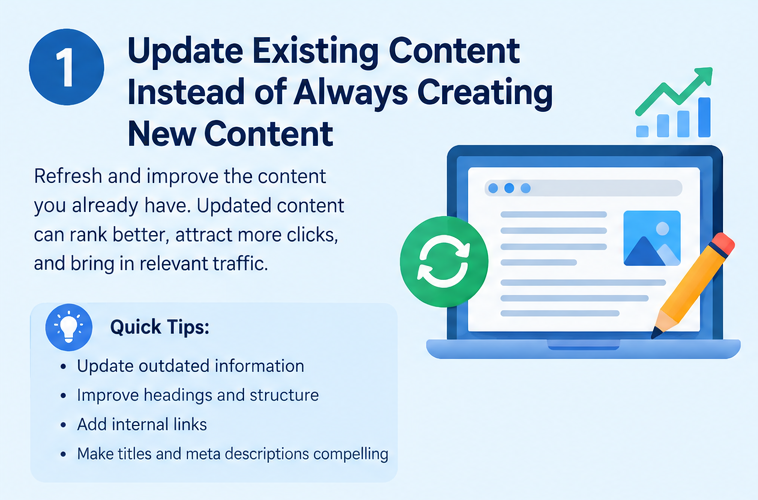
1. Update Existing Content Instead of Always Creating New Content
Publishing new blogs is useful, but updating existing content can also create valuable SEO opportunities.
Your website may already have pages receiving impressions but not enough clicks, blog posts ranking beyond the first page, or articles containing outdated information.
Start by identifying content that has potential for improvement.
What you can do:
- Update outdated statistics, examples, and information.
- Improve headings and content structure.
- Answer relevant questions your audience is searching for.
- Add useful internal links to related pages.
- Improve titles and meta descriptions to make them more relevant and compelling.
Use Google Search Console to identify pages with impressions, clicks, and queries that reveal opportunities for improvement.
Focus on helping users rather than simply adding more keywords.
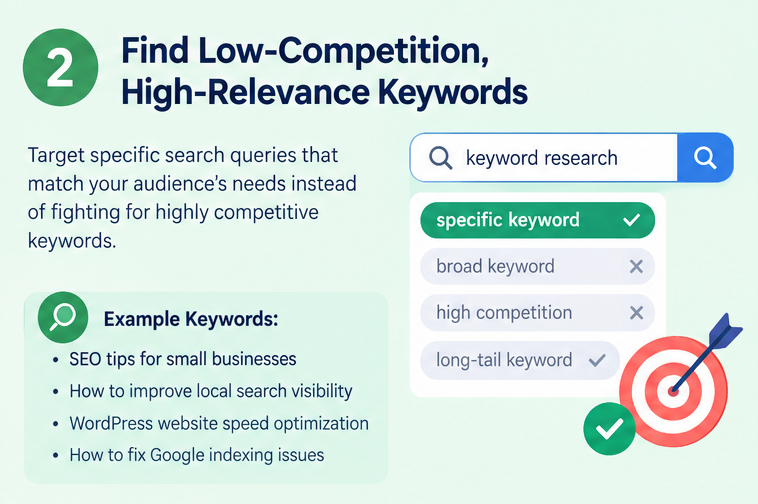
2. Find Low-Competition, High-Relevance Keywords
Targeting broad, highly competitive keywords can make it difficult for smaller websites to gain visibility.
Instead, focus on specific search queries that closely match your audience’s needs.
For example, rather than targeting only “digital marketing,” a business could explore more specific topics such as:
- SEO tips for small businesses
- How to improve local search visibility
- WordPress website speed optimization
- How to fix Google indexing issues
These are illustrative keyword ideas, not guaranteed low-competition terms. Validate search demand, competition, and relevance using keyword research tools and actual search results.
Pro tip: Look for keywords that reflect what your potential customers want to learn, solve, compare, or purchase.
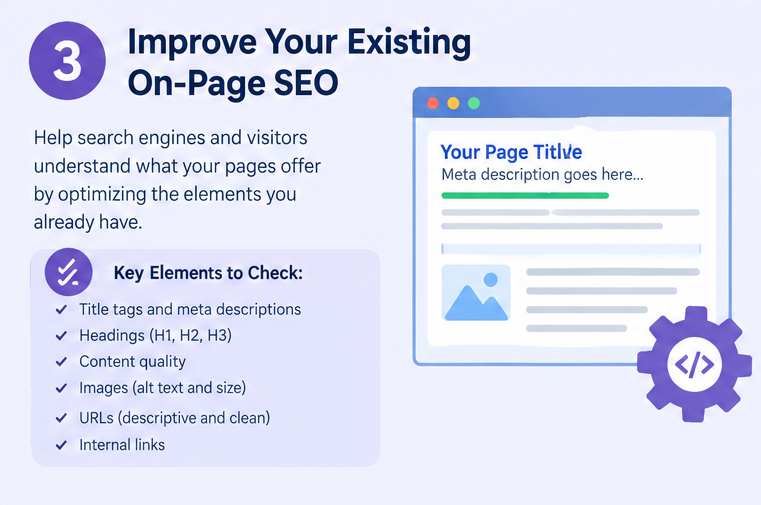
3. Improve Your Existing On-Page SEO
On-page SEO helps search engines and visitors understand what each page offers.
Before investing time in creating more content, review the pages you already have.
Check the following:
- Title tags: Clearly describe the page and its main topic.
- Meta descriptions: Summarize the page accurately and encourage relevant clicks.
- Headings: Organize information with logical H1, H2, and H3 headings.
- Content quality: Answer the searcher’s question clearly and thoroughly.
- Images: Use relevant visuals, descriptive alt text, and optimized file sizes.
- URLs: Keep URLs descriptive and easy to understand.
- Internal links: Connect related pages using helpful anchor text.
Avoid keyword stuffing and unnecessary changes to URLs, especially on pages already performing well.
4. Strengthen Your Internal Linking Strategy
Internal linking is one of the most practical SEO improvements you can make without additional software or advertising costs.
Internal links connect one page of your website to another, helping users discover related information and helping search engines understand your site’s structure.
For example, a blog about local SEO can link to a related Google Maps ranking guide, while a WordPress troubleshooting article can link to a relevant website optimization resource.
How to improve internal linking:
- Identify your most useful and relevant existing pages.
- Find related blog posts and service pages.
- Add contextual links where they genuinely help readers.
- Use descriptive anchor text.
- Check for broken links and important pages with few internal links.
Prioritize useful connections rather than adding links just to increase their number.
5. Turn Search Console Data Into Content Opportunities
Google Search Console is a valuable free resource for understanding how your website performs in Google Search.
Instead of guessing what to publish next, use the data to guide your content strategy.
Look for:
- Queries generating impressions but few clicks.
- Pages with declining clicks or impressions.
- Relevant queries where your pages have visibility but could better satisfy search intent.
- Pages that are ranking for unexpected but relevant searches.
For example, if a blog about website SEO receives impressions for questions that it barely addresses, consider improving the existing article or creating a separate, genuinely useful resource.
Remember that average position, CTR, and impressions vary by query, device, and search appearance. Evaluate patterns rather than judging a page using one metric alone.
6. Focus on Content That Solves Real Problems
Content that addresses real audience problems can attract relevant visitors and build trust over time.
Rather than publishing blogs just to maintain a posting schedule, build content around your audience’s actual questions.
Consider creating:
- Step-by-step tutorials
- Troubleshooting guides
- Practical checklists
- Industry explainers
- Case studies based on real results
- Frequently asked questions
For example, a WordPress development agency could publish guides about fixing indexing problems, improving website speed, resolving common WordPress errors, or submitting a sitemap to Google Search Console.
Your content should offer clear explanations, original insights, and practical next steps.
Quality and usefulness matter more than publishing volume.
7. Improve Your Website’s User Experience and Technical SEO
Organic traffic becomes more valuable when visitors can easily navigate your website and find what they need.
Technical problems can also affect how search engines access, crawl, and index your pages.
Review the following areas:
Website speed: Identify slow-loading pages and optimize oversized images, unnecessary scripts, and inefficient resources.
Mobile experience: Ensure your website is readable and easy to navigate on smaller screens.
Indexing: Check whether important pages are indexable and whether accidental noindex tags, canonical issues, or robots.txt rules are preventing discovery.
Site structure: Keep important pages accessible through clear navigation and internal links.
Core Web Vitals: Review real-user performance data where available and identify meaningful user experience improvements.
Use Google Search Console, PageSpeed Insights, and your existing WordPress tools to identify problems before adding new paid tools.
Avoid installing multiple optimization plugins that perform overlapping tasks.
8. Make Local SEO Work for Your Business
For businesses serving specific cities or regions, local SEO can help attract people searching for nearby products and services.
Start by optimizing your Google Business Profile if your business is eligible.
Local SEO actions to prioritize:
- Keep your business information accurate.
- Select appropriate business categories.
- Add genuine, relevant photos.
- Keep services and business details updated.
- Encourage honest customer reviews without incentives or pressure.
- Respond professionally to customer feedback.
- Build relevant local citations and industry relationships.
You can also create useful location-specific website content when it serves a real audience.
Avoid creating multiple near-identical city pages just to target keywords.
Local SEO works best when it reflects a real business presence and provides useful information to potential customers.
9. Repurpose Your Existing Content
You don’t always need to start from scratch to maintain a consistent content presence.
One well-researched blog can become several useful content assets.
For example, a blog about website indexing issues can be repurposed into:
- A short YouTube tutorial
- An Instagram carousel
- A LinkedIn educational post
- A downloadable checklist
- A short FAQ section for a related resource
Repurposing helps your team get more value from the work already completed.
Adapt the format and message for each platform instead of copying the same content everywhere.
Social engagement does not directly guarantee higher Google rankings, but content distribution can help people discover your brand, share your expertise, and find your website.
10. Earn Quality Backlinks Through Relationships and Useful Resources
Backlinks from relevant, trustworthy websites can support your website’s authority and discoverability.
However, gaining backlinks should focus on genuine value rather than chasing link counts.
Practical approaches include:
- Contributing expert insights to relevant industry publications.
- Creating original research or useful resources worth referencing.
- Building relationships with complementary businesses.
- Participating in legitimate industry associations.
- Reclaiming unlinked brand mentions where appropriate.
Avoid buying manipulative links, participating in link schemes, or creating low-quality directory submissions purely for SEO.
A few relevant editorial links can be more meaningful than a large number of unrelated links.
11. Measure Results and Prioritize What Works
SEO takes time, and not every improvement will produce immediate results.
Track meaningful metrics so you can focus your effort on activities that support business goals.
Use Google Search Console and GA4 to monitor:
- Organic clicks and impressions
- Organic click-through rate
- Search query performance
- Landing page traffic
- Organic engagement
- Qualified leads and enquiries
- Conversions, where tracking is configured correctly
Compare similar date ranges and account for seasonality, changes in demand, and website updates.
Don’t focus on traffic alone. A smaller number of relevant visitors who enquire about your services may be more valuable than a large number of unrelated visitors.
A Simple 30-Day Organic Traffic Improvement Plan
You don’t need to implement everything at once. Start with a focused plan using your existing resources.
Week 1: Audit
- Review Google Search Console performance.
- Identify your top-performing and underperforming pages.
- Check important technical SEO issues.
Week 2: Optimize
- Refresh two or three promising existing articles.
- Improve titles, headings, and internal links.
- Review important service pages.
Week 3: Create and distribute
- Publish one genuinely useful, search-focused resource.
- Repurpose an existing article into social content or a video.
- Update relevant local SEO information if applicable.
Week 4: Measure
- Review changes and establish a performance baseline.
- Check indexing, clicks, impressions, and engagement.
- Identify what to improve next.
This is a starting framework, not a guaranteed traffic-growth timeline. SEO improvements may take longer to become visible.
Final Thoughts
Increasing organic traffic without increasing your marketing budget is possible when you focus on smarter optimization, useful content, and consistent measurement.
Start with the opportunities already available on your website. Improve existing content, strengthen internal linking, resolve technical SEO problems, understand your audience’s search intent, and measure the outcomes that matter.
You don’t necessarily need more marketing activities. You need to make your existing activities more effective.
Looking to grow your website’s organic visibility?
At The Vanilla Theory, we believe sustainable digital growth starts with a strong strategy. From SEO and content strategy to website development and digital marketing, the right approach can help your business build visibility and connect with the right audience.
Frequently Asked Questions
1. How can I increase organic traffic for free?
Start by improving existing content, fixing technical SEO issues, optimizing internal links, researching relevant keywords, and using free resources such as Google Search Console and PageSpeed Insights.
2. How long does it take to increase organic traffic?
It depends on your website’s current condition, competition, search demand, and the improvements made. Some changes may show early signals within weeks, while meaningful organic growth can take several months or longer.
3. Is blogging still useful for SEO?
Yes, when your blogs address real user needs and provide useful information. Publishing content solely to target keywords or increase article count is unlikely to be an effective long-term strategy.
4. Can small businesses compete with bigger brands in SEO?
Yes, particularly by focusing on specific customer needs, relevant local searches, niche topics, original expertise, and high-quality service pages. Results depend on the market and competition.
5. Which free tools can help improve organic traffic?
Google Search Console, Google Analytics 4, Google Trends, and PageSpeed Insights can help with search performance analysis, traffic measurement, trend research, and website performance checks.


