
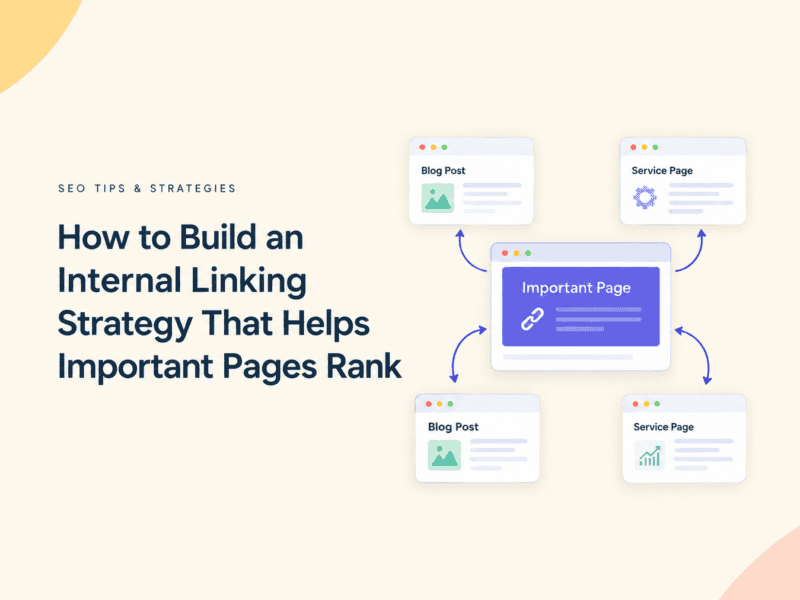
Your website may have valuable content, well-designed service pages, and a strong SEO foundation. But if your pages are not properly connected, visitors and search engines may struggle to discover your most important content.
This is where an internal linking strategy becomes essential.
Internal links help connect related pages, improve website navigation, and help search engines understand your website’s structure. When planned strategically, they can support your most important service pages, landing pages, and blogs.
In this guide, we will explain how to build an effective internal linking strategy that supports SEO performance and creates a better user experience.
What Is an Internal Linking Strategy?
An internal link is a hyperlink that connects one page of your website to another page on the same website.
For example, a blog about SEO fundamentals might link to your SEO services page, helping readers explore professional SEO solutions.
An internal linking strategy is the process of identifying which pages should link to one another, choosing relevant anchor text, and creating a logical website structure.
Unlike external links, which point to other websites, internal links help organize and connect your own content.
Why Internal Linking Matters for SEO
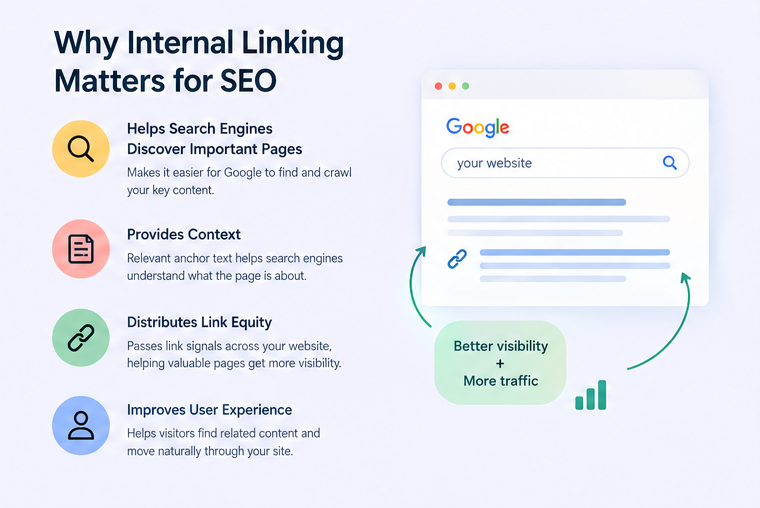
Internal linking is more than a navigation feature. It helps search engines discover and understand your content.
Here are some key benefits.
1. Helps Search Engines Discover Important Pages
Google uses links to discover pages and understand how content is connected. Pages with clear internal links are generally easier to find and crawl, although linking alone does not guarantee indexing.
2. Helps Search Engines Understand Page Context
Relevant anchor text gives users and search engines useful context about the destination page.
For example, linking with descriptive text such as “professional SEO services” provides more information than using generic text like “click here.”
3. Supports the Distribution of Link Equity
Internal links can help distribute link signals across your website. Pages that receive relevant links from other useful pages may benefit from those signals.
However, more internal links do not automatically mean higher rankings. Relevance, quality, accessibility, and the overall website context matter.
4. Improves User Experience
When readers find helpful links within your content, they can explore related topics, understand your services, and move naturally through your website.
A good internal linking strategy supports both search visibility and conversions.
How to Build an Internal Linking Strategy Step by Step
Creating a strong internal linking strategy does not require adding links randomly. Start with a clear plan.
Step 1: Identify Your Most Important Pages
First, decide which pages deserve the most attention.
These may include:
- Main service pages
- High-converting landing pages
- Core product pages
- Important category pages
- High-value informational resources
For a digital marketing agency, priority pages could include SEO Services, Google Ads Management, Social Media Marketing, and Website Development.
Consider business value, search intent, current performance, and conversion potential when choosing your priority URLs.
Pro tip: Your homepage is important, but it does not need to link to every page. Focus on building a meaningful structure.
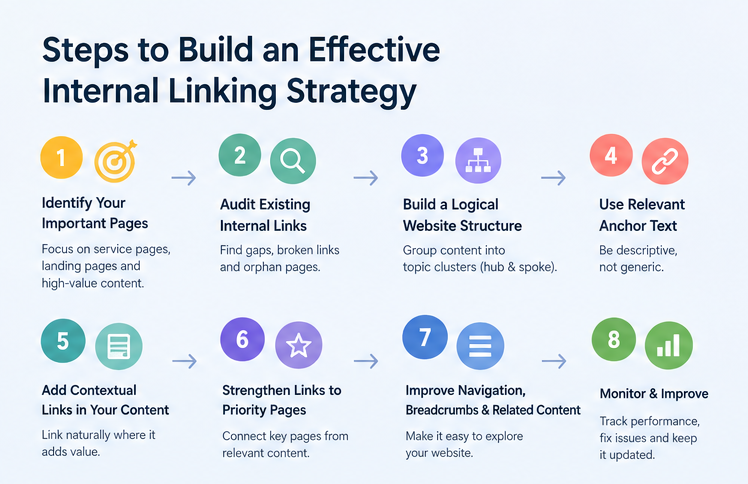
Step 2: Audit Your Existing Internal Links
Before creating new links, understand your current website structure.
Use tools such as:
- Google Search Console to review indexing and performance
- Screaming Frog SEO Spider to crawl internal links
- Sitebulb to visualize website structure
- WordPress SEO plugins for basic SEO checks
During your audit, look for:
- Important pages with very few internal links
- Orphan pages with no discoverable internal links
- Broken internal links
- Redirected internal links
- Pages with excessive or irrelevant links
- Important pages buried too deeply in navigation
An internal link audit helps identify gaps and opportunities.
Step 3: Build a Logical Website Structure
Organize your content into clear topic groups.
A practical structure is a hub-and-spoke model, where a main topic page connects to supporting content.
For example:
SEO Services (Main Service Page)
- Complete SEO Checklist 2026
- Local SEO Guide
- Website Architecture for SEO
- Google Indexing Issues Guide
- Impressions but No Clicks: SEO Fixes
Each relevant supporting blog can link to the SEO services page when it genuinely helps readers. The service page can also link back to relevant educational resources.
This creates a connected content ecosystem instead of isolated pages.
Step 4: Use Relevant and Descriptive Anchor Text
Anchor text is the clickable text within a hyperlink.
Choose text that accurately describes the destination page.
Examples:
- Better: “Explore our SEO services”
- Better: “Learn how to improve your local SEO”
- Avoid: “Click here” when a descriptive phrase would be more helpful
- Avoid: Repeating the exact same keyword unnaturally across every link
Your anchor text should sound natural and fit the surrounding sentence.
Do not force keywords into every internal link.
Step 5: Add Contextual Links Within Your Content
Contextual links appear naturally inside the main content of a page.
These links can be especially useful because they connect related information at the moment a reader needs it.
For example, in a blog about website traffic, you might write:
“Before focusing on traffic growth, make sure your website follows a complete SEO checklist that covers technical health, on-page optimization, and content quality.”
The phrase “complete SEO checklist” can link to your relevant guide.
Similarly, a blog discussing Google indexing problems could link to another article explaining how to submit a sitemap in Google Search Console.
Always ensure that the destination genuinely adds value.
Step 6: Strengthen Links to Your Priority Pages
Once your structure is clear, identify relevant pages that can link to your priority URLs.
For example, if your SEO services page is a business priority, consider adding relevant links from:
- SEO educational blogs
- Website optimization guides
- Case studies
- Related service pages
- Useful resource pages
Prioritize pages that are relevant, useful, and already receive meaningful visits or links.
Avoid adding links solely to increase a numerical internal link count.
Step 7: Review Navigation, Breadcrumbs, and Related Content
Internal links are not limited to blog paragraphs.
You can also improve navigation through:
- Main navigation menus
- Breadcrumbs
- Related blog sections
- Service page cross-links
- Helpful footer links
Breadcrumbs can help visitors understand where they are within your website.
Keep navigation simple and avoid turning your footer or sidebar into a list of keyword-heavy links.
Step 8: Monitor and Improve Your Strategy
Internal linking is an ongoing SEO activity.
Review your internal link structure regularly, especially when publishing new content, changing URLs, or redesigning your website.
Track:
- Internal links pointing to priority pages
- Orphan and broken pages
- Google Search Console impressions and clicks
- Organic landing page traffic
- Rankings for relevant queries
- Leads and conversions from organic visitors
Google Search Console does not provide a complete internal link audit, so combine its performance data with a website crawler.
Measure performance over time rather than expecting immediate ranking changes.
Internal Linking Mistakes to Avoid
Even a well-intentioned strategy can create problems when links are added without a clear purpose.
Avoid these common mistakes:
- Adding irrelevant links: Links should help readers discover related information.
- Using keyword-stuffed anchor text: Keep anchor text descriptive and natural.
- Ignoring orphan pages: Important content should have discoverable links.
- Linking to broken URLs: Check for outdated links after website updates.
- Overloading pages with links: There is no universal ideal number of links per page. Add links where they are useful.
- Using only the homepage to link everywhere: Build a balanced and logical website structure.
- Ignoring mobile navigation: Make sure internal links are accessible and easy to use on smaller screens.
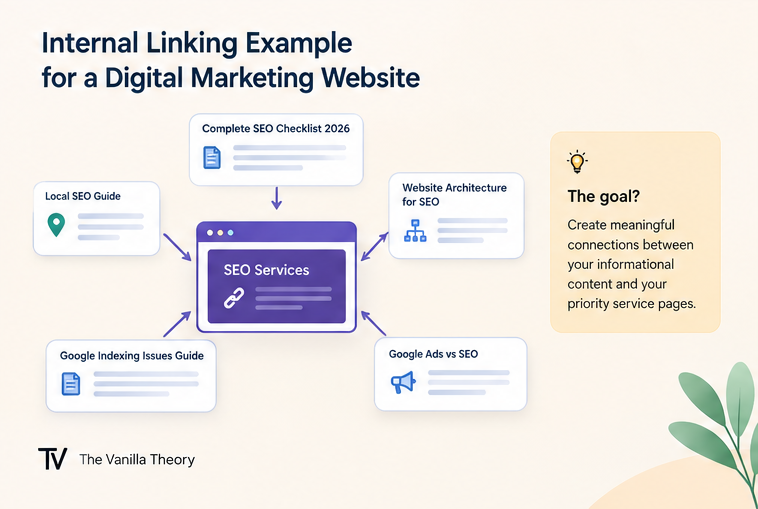
Internal Linking Strategy Example for The Vanilla Theory
For a digital marketing website like The Vanilla Theory, internal links can connect educational content with relevant services.
| Existing content | Relevant destination |
|---|---|
| Complete SEO Checklist 2026 | SEO Services |
| Local SEO Guide | Local SEO / SEO Services |
| Website Architecture for SEO | SEO Services |
| Google Indexing Issues Guide | SEO Services or related technical SEO content |
| Google Ads vs SEO | Google Ads Management and SEO Services, where relevant |
These are suggested linking opportunities. Before implementation, verify the live URLs and ensure that each destination matches the reader’s intent.
You can also link from service pages to supporting blogs to help potential clients understand your process and expertise.
The goal is to create meaningful connections between your informational content and commercial pages.
Your Internal Linking Checklist
Before publishing a new blog or updating an existing page, review this checklist:
- Identify the primary topic and search intent.
- Choose the most relevant existing pages to link to.
- Add descriptive, natural anchor text.
- Link to useful supporting content.
- Check that links work and point to the correct URLs.
- Ensure the destination pages are accessible to search engines.
- Review the page on mobile.
- Update your internal link audit if necessary.
Final Thoughts
An effective internal linking strategy helps create a website that is easier to navigate, understand, and explore.
By identifying your priority pages, organizing content into relevant topic groups, using descriptive anchor text, and regularly auditing your internal links, you can strengthen your website’s SEO foundation.
Remember, internal linking is not about adding as many links as possible. It is about creating the right connections between the right pages.
Want to build a stronger SEO foundation for your website? The Vanilla Theory can help you develop a strategic approach to SEO, content optimization, and website performance.
Explore our digital marketing solutions and discover how a smarter SEO strategy can support your business growth.


