
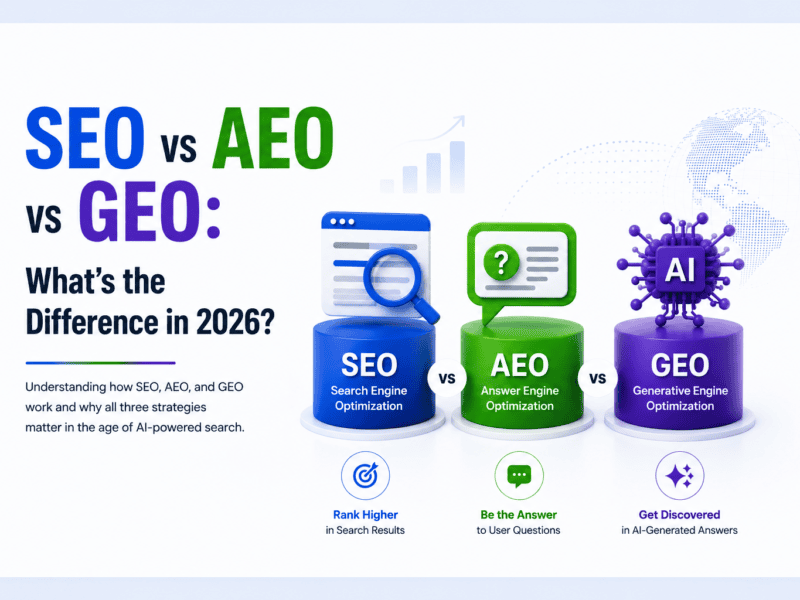
Search is changing faster than ever. People are no longer relying only on traditional Google search results to find information. They are also asking AI tools such as ChatGPT, Google AI Overviews, Gemini, and other AI-powered search platforms for direct answers.
This shift has introduced three important digital marketing strategies: SEO, AEO, and GEO.
While all three aim to improve online visibility, they focus on different ways people discover information.
In this guide, we’ll explain the difference between SEO vs AEO vs GEO, how each strategy works, and why businesses should consider all three in their 2026 search strategy.
What is SEO?
SEO (Search Engine Optimization) is the process of improving a website so that it appears higher in traditional search engine results.
For example, if someone searches:
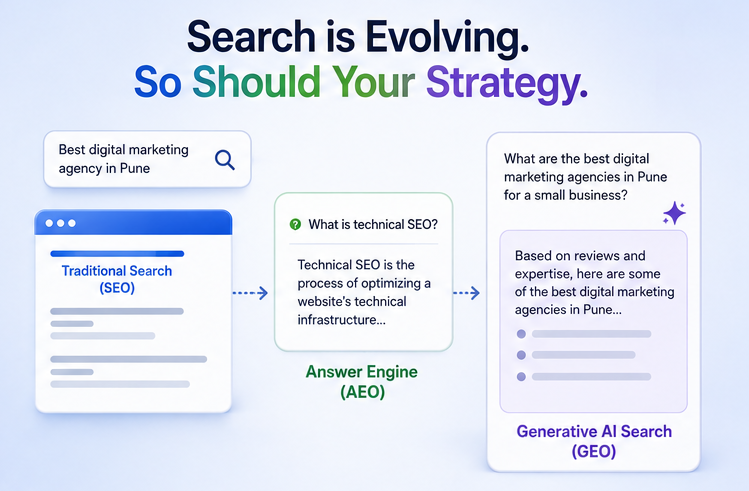
“Best digital marketing agency in Pune”
SEO helps your website compete for visibility on Google’s search results page.
Traditional SEO focuses on areas such as:
- Keyword research
- On-page optimization
- Technical SEO
- Website speed
- Internal linking
- Backlink building
- Content quality
- Mobile optimization
- Local SEO
- Search intent
The main goal of SEO is to help search engines crawl, understand, index, and rank your website.
Why SEO Still Matters in 2026
AI search has changed how people search, but traditional search engines remain an important source of traffic.
A strong SEO foundation also makes it easier for search engines and AI systems to understand your website.
So, SEO isn’t disappearing. Instead, it is becoming part of a broader search visibility strategy.
What Is AEO?
AEO (Answer Engine Optimization) focuses on optimizing content so that it can provide direct answers to users’ questions.
Instead of only trying to rank for a keyword, AEO focuses on answering the question behind the search.
For example:
Search query:
“What is technical SEO?”
An AEO-friendly page might begin with a clear definition:
“Technical SEO is the process of optimizing a website’s technical infrastructure so that search engines can crawl, index, and understand its content more effectively.”
The answer is short, direct, and easy for search engines or answer engines to understand.
How AEO Works
AEO typically focuses on:
- Question-based keywords
- Clear definitions
- FAQs
- Concise answers
- Structured content
- Conversational search queries
- Featured-snippet optimization
- Schema markup
- Search intent
AEO is particularly useful for searches such as:
- What is SEO?
- How does local SEO work?
- Why is my website not ranking?
- How much does SEO cost?
- How can I improve website traffic?
The objective is to make your content easy to extract and present as an answer.
What Is GEO?
GEO (Generative Engine Optimization) is the practice of optimizing content so that it has a better chance of being discovered, understood, referenced, or represented by generative AI and AI-powered search systems.
Instead of focusing exclusively on traditional rankings, GEO considers how AI systems interpret information and construct answers.
For example, a user might ask an AI search tool:
“What are the best digital marketing agencies in Pune for a small business?”
Rather than receiving a traditional list of ten blue links, the user may receive an AI-generated response containing recommendations and supporting information.
GEO aims to make your brand and content more useful and recognizable within this type of search experience.
How GEO Works
GEO can involve:
- Creating authoritative content
- Demonstrating expertise and experience
- Providing original information
- Building brand mentions and citations
- Publishing trustworthy content
- Structuring information clearly
- Supporting claims with credible sources
- Creating comprehensive topical coverage
- Maintaining accurate business information
The goal is not simply to rank for a keyword.
The goal is to make your brand and information valuable enough for AI systems to understand and potentially reference.
SEO vs AEO vs GEO: The Key Difference
The easiest way to understand the difference is to look at what each strategy is trying to optimize for.
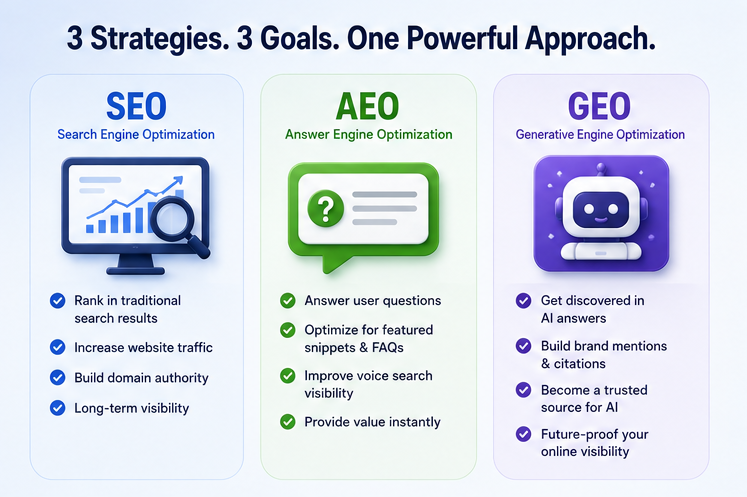
| Strategy | Main Focus | Primary Goal |
| SEO | Search engines | Improve traditional search rankings |
| AEO | Answer engines | Provide direct answers to questions |
| GEO | Generative AI search | Increase visibility in AI-generated answers |
Think of them this way:
SEO = Rank
AEO = Answer
GEO = Get discovered in AI-generated responses
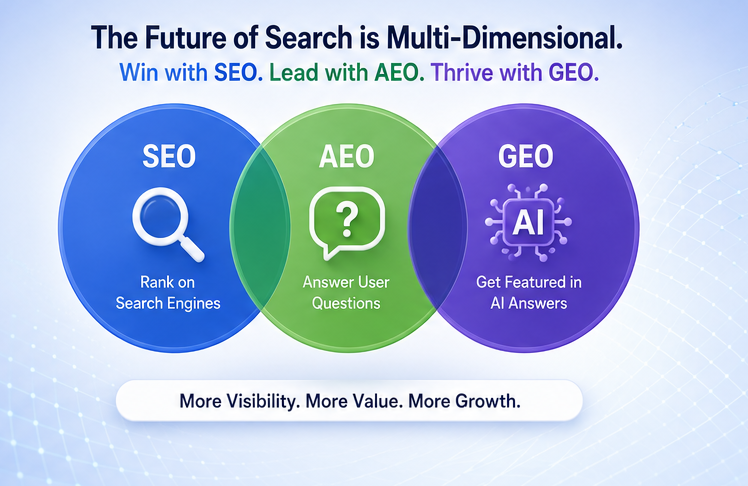
These strategies overlap, but they are not exactly the same.
SEO vs AEO vs GEO: How They Work Together
The biggest mistake businesses can make in 2026 is treating SEO, AEO, and GEO as completely separate strategies.
In reality, they work together.
Imagine you publish an article titled:
“How Much Does Digital Marketing Cost in Pune in 2026?”
SEO Approach
You optimize the page for relevant search terms such as:
- digital marketing cost in Pune
- digital marketing agency pricing
- digital marketing services cost
You also improve technical SEO, internal links, page speed, and authority.
AEO Approach
You answer specific questions clearly:
- How much does digital marketing cost?
- What services are included?
- How much does SEO cost?
- How much should a small business spend?
You organize these answers using clear headings and concise paragraphs.
GEO Approach
You make the content more authoritative by including:
- Practical examples
- Original insights
- Industry data
- Expert explanations
- Clear service information
- Relevant supporting sources
- Strong brand expertise
The result is one piece of content designed for traditional search, answer engines, and AI-powered search.
SEO vs AEO vs GEO: Content Strategy Differences
The type of content you create can also differ.
SEO Content
SEO traditionally emphasizes content targeting specific keywords and search intent.
Examples:
- “Best SEO Services in Pune”
- “Digital Marketing Agency in Pune”
- “Local SEO Guide”
AEO Content
AEO works especially well with question-driven content.
Examples:
- “What Is Local SEO?”
- “How Does Google Maps Ranking Work?”
- “How Long Does SEO Take?”
GEO Content
GEO benefits from deeper, authoritative content that AI systems can interpret and connect with a topic.
Examples:
- Industry guides
- Original research
- Expert analysis
- Detailed comparisons
- Case studies
- Statistics and reports
- Comprehensive resource pages
The strongest strategy is to combine all three rather than choosing only one.
How AI Search Is Changing SEO in 2026
AI-powered search is changing the user’s journey.
Previously, the process often looked like:
Search → Browse results → Click website → Read content
Now it can look more like:
Ask AI → Receive synthesized answer → Explore sources or brands
This means businesses need to think beyond rankings.
A website can potentially benefit from being:
- A search result
- A direct answer source
- A referenced source
- A recognized brand
- An authority on a particular topic
This is why modern SEO is increasingly becoming about overall search visibility, rather than rankings alone.
7 Ways to Optimize Your Website for SEO, AEO & GEO
1. Create Content Around Search Intent
Don’t create content simply because a keyword has search volume.
Understand what users actually want.
For example:
Keyword: “SEO agency Pune”
The searcher may want:
- Agency recommendations
- Pricing
- Services
- Reviews
- Results
- Contact information
Your content should address those needs.
2. Answer Questions Clearly
Include relevant questions throughout your content.
Use headings such as:
- What is SEO?
- What is AEO?
- What is GEO?
- How does GEO work?
- What is the difference between SEO and AEO?
Then provide direct answers.
This makes your content easier for both users and search systems to understand.
3. Build Topic Authority
Instead of publishing one article about SEO, create a network of useful content.
For example:
SEO
→ Technical SEO
→ Local SEO
→ On-Page SEO
→ Off-Page SEO
→ Keyword Research
→ SEO Audits
This creates stronger topical coverage and helps establish your website as a useful resource.
4. Use Structured Content
Make your content easy to understand.
Use:
- H2 and H3 headings
- Short paragraphs
- Bullet points
- Tables
- FAQs
- Definitions
- Examples
- Relevant schema markup
Good structure benefits both users and automated systems that need to interpret your content.
5. Demonstrate Real Expertise
Generic AI-generated content is becoming easier to produce.
That makes first-hand experience and original insights more valuable.
Add:
- Case studies
- Real examples
- Original research
- Expert opinions
- Data
- Results
- Unique observations
Don’t just repeat information that already exists on hundreds of websites.
6. Strengthen Your Brand Presence
GEO isn’t only about your website.
Your brand can appear across the wider web through:
- Industry publications
- Business directories
- Professional profiles
- Reviews
- Digital PR
- Relevant partnerships
- Social platforms
- Third-party mentions
A consistent and trustworthy online presence can strengthen your overall digital visibility.
7. Keep Information Accurate and Updated
Search and AI systems need reliable information.
Regularly update:
- Services
- Pricing information
- Company information
- Statistics
- Author information
- Old blog posts
- Business profiles
- Contact details
A website that was accurate two years ago may contain outdated information today.
Which Is More Important: SEO, AEO or GEO?
The answer is all three. SEO remains important because traditional search still drives significant discovery.
AEO matters because users increasingly search through questions and expect direct answers. GEO matters because generative AI is becoming another way people discover information, brands, products, and services.
Instead of asking:
“Should I focus on SEO or GEO?”
Businesses should ask:
“How can I make my website visible across every major search experience?”
That’s the more useful question for 2026.
The Future of Search: From Rankings to Visibility
SEO used to be heavily focused on one question:
“What position does my website rank at?”
The future is broader.
Businesses should also consider:
- Does Google understand my website?
- Can users find direct answers from my content?
- Does my brand appear for relevant questions?
- Is my content authoritative?
- Is my business mentioned across trusted sources?
- Can AI systems understand what my company does?
- Does my website provide useful first-hand information?
This represents a shift from ranking optimization to search visibility optimization.
SEO + AEO + GEO: The 2026 Strategy
A strong 2026 search strategy can be summarized as:
SEO → Build search visibility
AEO → Provide direct answers
GEO → Build visibility within generative search
Together, they create a more complete approach to modern search marketing.
Businesses that continue focusing only on traditional keyword rankings may miss opportunities as search behavior evolves.
Businesses that combine technical SEO, useful answers, authoritative content, structured information, and strong brand visibility will be better positioned for the changing search landscape.
Final Thoughts
SEO, AEO, and GEO are not competing strategies. They are different parts of the modern search ecosystem.
SEO helps your website get found.
AEO helps your content answer questions.
GEO helps your brand and information become more useful and discoverable in AI-powered search experiences.
In 2026, the goal shouldn’t simply be to rank #1 for a keyword.
The bigger goal is to become the source people — and increasingly AI systems — can find, understand, trust, and choose.
Looking to Improve Your Search Visibility?
At The Vanilla Theory, we help businesses build stronger digital visibility through SEO, content strategy, website development, and digital marketing.
Whether your goal is to rank higher on Google, generate more qualified leads, or prepare your website for AI-powered search, a well-planned search strategy can help you stay ahead as the search landscape evolves.
The future of search isn’t just about ranking. It’s about being visible everywhere your customers are searching.


