
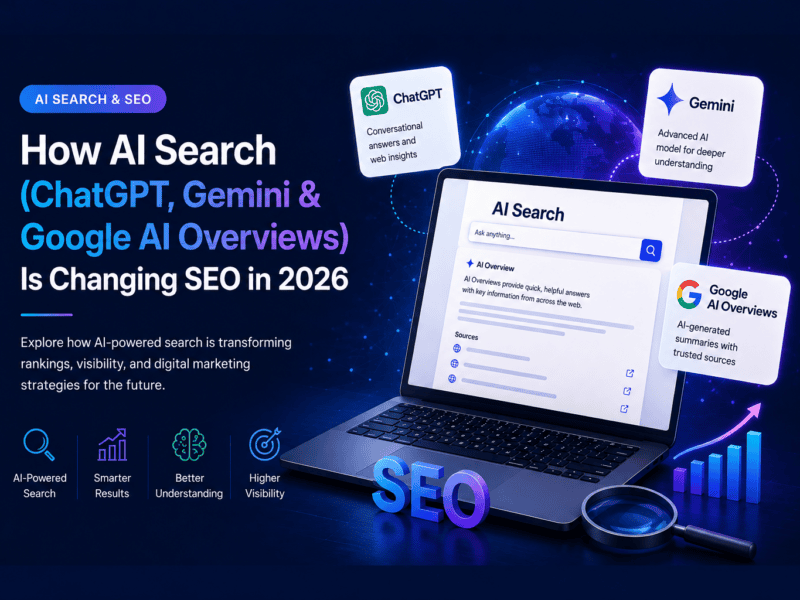
AI Search SEO combines traditional SEO principles with strategies designed to improve visibility across AI-powered search experiences.
AI Search SEO in 2026 is changing how businesses get discovered online. Search engines are evolving with platforms such as ChatGPT, Gemini, and Google AI Overviews, making it increasingly important for businesses to optimize their websites for both traditional and AI-powered search.
People are changing the way they search for information, compare businesses, research products, and make buying decisions. Instead of typing short keywords into a traditional search box and opening multiple websites, users can now ask detailed questions to AI-powered search platforms such as ChatGPT, Google AI Overviews, Google AI Mode, and Gemini and receive synthesized answers with relevant sources and links.
This shift is creating a new challenge for businesses:
How do you make your website visible when an AI answers the customer’s question instead of showing a traditional list of search results?
The answer isn’t to abandon SEO.
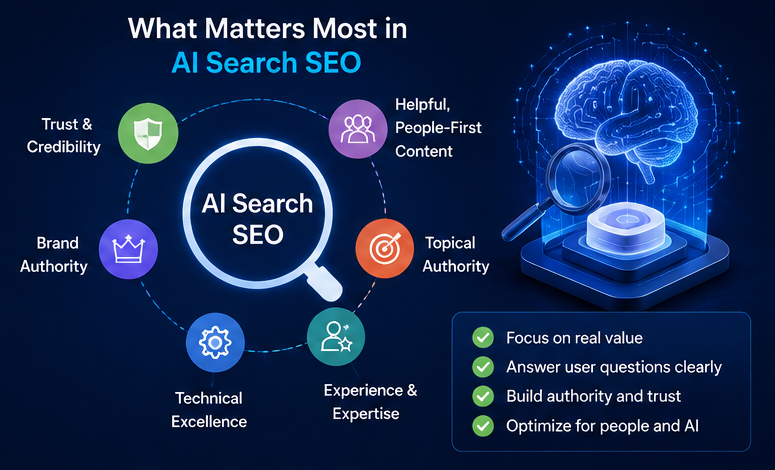
Instead, SEO is becoming broader. Businesses need to optimize not only for traditional rankings but also for visibility, credibility, context, and citations across AI-powered search experiences.
In this guide, we’ll explore how AI search is changing SEO in 2026, what it means for businesses, and what you can do to prepare your website for the future of search.
What Is AI Search?
AI search uses artificial intelligence to understand a user’s question, retrieve relevant information, analyze multiple sources, and generate a conversational answer.
Traditional search generally works like this:
User → Search Query → Search Results → Website → Answer
AI-powered search increasingly works like this:
User → Natural-Language Question → AI Research → Synthesized Answer → Sources/Links → Website
For example, instead of searching: “best digital marketing agency Pune”
a user might ask:
“Which digital marketing agencies in Pune are best for a small manufacturing company that wants to generate B2B leads through SEO and Google Ads?”
That’s a much more detailed search intent.
AI systems can interpret the context, compare information, and provide a more personalized response.
Google has been expanding AI Overviews and AI Mode to support more complex searches, while ChatGPT can search the web and provide answers with links to relevant sources.
This means businesses need to think beyond individual keywords.
Traditional SEO vs AI Search SEO
Traditional SEO focuses heavily on:
- Keywords
- Search rankings
- Backlinks
- Technical SEO
- Content optimization
- Click-through rates
- Organic traffic
AI search adds another layer:
- Brand mentions
- Topical authority
- First-hand expertise
- Clear answers
- Structured information
- Entity understanding
- Trust signals
- Content relevance
- Source credibility
- Citations and references
The goal is no longer simply:
“How do I rank #1?”
It is increasingly:
“How do I become one of the sources an AI system trusts enough to mention?”
That is a major change in SEO strategy.
How ChatGPT Is Changing Search
ChatGPT has become an important research and discovery tool because users can ask questions conversationally rather than constructing traditional keyword queries.
For example, someone looking for website development services might ask:
“What should I look for when choosing a website development company in Pune?”
Instead of presenting ten blue links, an AI system can summarize important considerations and potentially reference websites that provide useful information.
OpenAI introduced ChatGPT search to provide timely answers using information from the web and links to relevant sources.
What does this mean for SEO?
Your website needs to be:
- Discoverable
- Crawlable
- Relevant
- Credible
- Helpful
- Clearly structured
Publishing hundreds of generic AI-generated articles isn’t enough.
Your content needs to provide real value that can be understood and trusted by both people and search systems.
How Google AI Overviews Are Changing SEO
Google AI Overviews place AI-generated summaries directly within Google Search.
Instead of seeing only traditional organic listings, users may see an AI-generated explanation followed by supporting links.
Google’s current guidance makes an important point:
SEO is still relevant for AI search.
Google explains that its generative AI search experiences are built on its existing Search ranking and quality systems. Its guidance recommends continuing to follow foundational SEO practices while creating unique, helpful, people-first content.
This means businesses don’t need to completely replace their SEO strategy.
They need to evolve it.
Google AI Mode: The Next Evolution of Search
Google AI Mode takes AI-powered search further by allowing users to ask more complex questions and continue the conversation through follow-up queries.
Google has continued expanding AI Mode and AI Overviews in 2026, including capabilities designed to help users explore websites, information, and original content more deeply.
This creates a new type of search behavior.
A user might start with:
“Best website development companies in Pune”
Then continue:
“Which ones specialize in B2B websites?”
Then:
“Which one is affordable for a startup?”
Then:
“What should I ask before hiring one?”
The search journey becomes conversational rather than a series of disconnected keyword searches.
Gemini and the Growth of Conversational Search
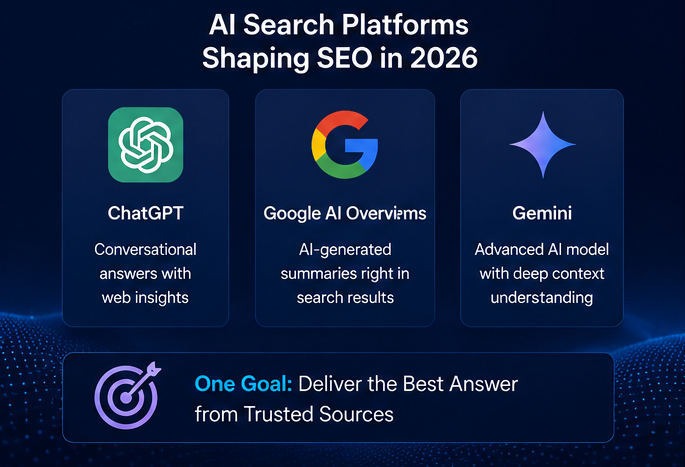
Google’s Gemini technology plays an increasingly important role in Google’s AI-powered search experiences.
The important SEO implication isn’t simply “optimize for Gemini.”
Instead, businesses should focus on creating content that clearly answers real questions and demonstrates expertise.
Google’s AI search guidance emphasizes valuable, unique, non-commodity content rather than relying on artificial optimization tricks.
So rather than creating an article like:
“Best Website Development Company Pune | Website Development Pune | Pune Website Developers”
create something genuinely useful:
“How to Choose a Website Development Company in Pune: 10 Questions to Ask Before Hiring”
The second article provides context, expertise, and useful information that can potentially satisfy several related search intents.
Zero-Click Searches Are Becoming More Important
One of the biggest changes created by AI search is the growth of zero-click experiences.
A zero-click search happens when a user gets enough information directly from the search interface without clicking a traditional result.
For example:
Traditional search:
Search → Result → Website → Information
AI search:
Search → AI answer → Sources → Optional website visit
This can reduce clicks for some informational queries.
But it doesn’t mean website traffic becomes irrelevant.
Instead, the value of visibility changes.
A user may see your brand in an AI-generated answer, remember your company, and visit your website later when they’re ready to purchase.
This makes brand visibility and authority increasingly important SEO metrics.
SEO Is Moving From Keywords to Search Intent
Keywords are still important.
But keyword-only strategies are becoming less effective.
Consider these searches:
- SEO agency Pune
- best SEO agency Pune
- affordable SEO agency Pune
- SEO company for startups Pune
- SEO services for manufacturing companies
- local SEO company Pune
A traditional strategy might create separate pages for every keyword variation.
An AI-focused strategy asks:
What problem is the customer actually trying to solve?
For example:
“How can a manufacturing company in Pune generate qualified B2B leads through Google?”
This single topic can naturally cover:
- SEO
- Google Ads
- landing pages
- local SEO
- content marketing
- lead generation
- conversion optimization
That’s much closer to how users actually think.
Topical Authority Is Becoming More Important
AI systems need context.
If your website has one article about SEO and another article about web development, it may be difficult for search systems to understand your overall expertise.
But imagine a website with dozens of genuinely useful resources around:
SEO → Local SEO → Technical SEO → Google Ads → Content Marketing → Lead Generation → Analytics → Website Development
The website creates a stronger topical relationship around digital marketing.
This is why businesses should build topic clusters instead of publishing random blog posts.
Example Topic Cluster
Pillar Page:
Digital Marketing for Businesses in Pune
Supporting content:
- Local SEO Guide for Pune Businesses
- Google Ads for Pune Businesses
- SEO vs Google Ads
- How to Generate B2B Leads Online
- Website Conversion Optimization
- Content Marketing Strategy
- Google Business Profile Optimization
Each article can link naturally to related resources.
Original Expertise Matters More Than Ever
AI can generate generic content extremely quickly.
That creates a problem:
Generic content is becoming a commodity.
If 1,000 websites publish essentially the same AI-generated article about:
“10 Benefits of Digital Marketing”
why should an AI system—or a human—prefer one over another?
The answer is original value.
Add:
- Real examples
- Original research
- Case studies
- Expert opinions
- Data
- Screenshots
- Customer questions
- Industry-specific recommendations
- First-hand experience
- Unique processes
Google specifically recommends creating content that is helpful, reliable, people-first, and provides value beyond common knowledge.
AI-Generated Content Is Not Automatically Bad
Using AI to help create content isn’t necessarily a problem.
The problem is using AI to mass-produce low-value content without adding anything useful.
Google’s guidance says generative AI can be useful for research and structuring content, but generating many pages without adding value can violate its policies against scaled content abuse.
A better workflow is:
AI → Research → Human Expertise → Original Insights → Editing → Fact Checking → Publishing
Not:
AI → Generate 100 articles → Publish
AI should accelerate your content process, not replace expertise.
What Makes Content More Visible in AI Search?
There is no guaranteed formula for appearing in ChatGPT, Gemini, or Google AI Overviews.
However, several principles are increasingly important.
1. Answer Questions Clearly
Don’t make users search through 2,000 words to find a simple answer.
Use clear sections such as:
What is SEO?
How much does SEO cost?
How long does SEO take?
Is SEO better than Google Ads?
Clear answers make content easier for both users and search systems to understand.
2. Build Strong Topic Coverage
Don’t create isolated articles.
Create connected content around your main expertise.
For example, an SEO agency could build content around:
SEO
→ Technical SEO
→ Local SEO
→ On-page SEO
→ Off-page SEO
→ Keyword research
→ Content strategy
→ Google Search Console
→ AI search optimization
This creates stronger topical depth.
3. Use Specific Information
Generic:
“SEO is important for businesses.”
Better:
“For local businesses, SEO can help increase visibility when potential customers search for services in their city.”
Specific content provides more context and usefulness.
4. Demonstrate Experience
Add things that AI cannot easily reproduce from generic training data:
- Original case studies
- Campaign results
- Screenshots
- Client examples
- Before-and-after comparisons
- Original research
- Expert interviews
These elements make your content more distinctive.
Structured Content Helps Search Engines Understand Your Website
Technical SEO remains important.
Make sure your website has:
- Clean URLs
- Logical navigation
- Internal linking
- XML sitemap
- Proper indexing
- Mobile responsiveness
- Fast loading times
- HTTPS
- Descriptive headings
- Optimized images
- Appropriate structured data
Google’s guidance specifically states that foundational SEO remains important for visibility in generative AI search experiences.
AI search doesn’t eliminate technical SEO.
It makes having a technically accessible website even more important.
Internal Linking Is More Important Than Ever
Internal links help search engines understand the relationship between your pages. Suppose you publish:
SEO Services in Pune
You could link to:
- Local SEO
- Technical SEO
- SEO Audit
- Keyword Research
- Content Marketing
- Google Search Console
- Google Ads
- Website Development
This creates a connected information architecture.
Think of your website as a knowledge network rather than a collection of independent pages.
Build Your Brand Across the Web
AI systems don’t necessarily understand your business only from your homepage. Your brand can appear across:
- Industry websites
- Business directories
- News websites
- Reviews
- YouTube
- Forums
- Professional publications
- Partner websites
But don’t chase random mentions simply for the sake of appearing somewhere. Google’s guidance warns against strategies such as pursuing inauthentic mentions and emphasizes high-quality content and genuine authority. Focus on relevant and credible visibility.
Reviews and Local SEO Still Matter
For local businesses, AI search doesn’t make local SEO obsolete. It makes accurate business information even more important. Maintain:
- Google Business Profile
- Accurate business name
- Address
- Phone number
- Website
- Opening hours
- Services
- Reviews
- Business categories
- Photos
Google specifically notes that Business Profiles and relevant business information can help businesses become visible in AI responses and traditional Search.
The New SEO Metrics for 2026
Traditional SEO reporting often focuses on:
- Rankings
- Organic traffic
- Impressions
- Clicks
- CTR
- Backlinks
These metrics still matter. But businesses should increasingly monitor:
Brand mentions
How often is your company mentioned in AI-generated answers and across the web?
AI visibility
Does your brand appear when users ask relevant questions?
Citation frequency
Are authoritative websites mentioning your company?
Branded searches
Are more people searching specifically for your brand?
Assisted conversions
Did a user discover your brand through search and convert later through another channel?
Organic conversions
Ultimately, traffic matters less than business outcomes.
Track:
Search visibility → Website visit → Lead → Qualified lead → Customer
Google Search Console Is Evolving
Google has introduced a dedicated Generative AI performance report in Search Console to help website owners understand visibility from generative AI features such as AI Overviews and AI Mode.
This is significant because SEO reporting is moving beyond traditional blue-link performance.
Businesses can increasingly analyze how their websites are being discovered through AI-powered Search experiences.
That means SEO teams should start including AI visibility in regular reporting.
How Businesses Should Adapt Their SEO Strategy in 2026
A modern SEO strategy should have several layers.
Layer 1: Technical SEO
Make your website easy to crawl, understand, and index. Focus on:
- Core Web Vitals
- Mobile performance
- Indexing
- Site architecture
- HTTPS
- Structured data
- XML sitemap
- Internal links
Layer 2: Search Intent
Create content based on what your customers actually want to know. Instead of:
“SEO Keywords”
target questions such as:
“How many keywords should a small business target?”
Layer 3: Topical Authority
Build comprehensive coverage around your primary service or industry. Don’t publish random articles. Build connected knowledge.
Layer 4: Original Expertise
Add information that cannot easily be copied from competitors. Use:
- Case studies
- Data
- Expert insights
- Original research
- Examples
- Visuals
- Customer experiences
Layer 5: Brand Authority
Build legitimate visibility beyond your own website. Earn:
- Mentions
- Reviews
- Editorial links
- Industry references
- Partnerships
- Social visibility
Layer 6: Conversion Optimization
AI search may introduce your brand to a potential customer. Your website needs to convert that attention into action. Improve:
- Landing pages
- Calls-to-action
- Contact forms
- Trust signals
- Case studies
- Testimonials
- Service pages
- Pricing information
- Lead capture
Because visibility without conversion isn’t a successful SEO strategy.
What About GEO and AEO?
You may have heard of:
GEO — Generative Engine Optimization
and
AEO — Answer Engine Optimization
These terms describe efforts to improve visibility within AI-generated or answer-focused search experiences. However, businesses shouldn’t treat GEO as a collection of secret hacks.
Google’s official guidance explicitly says that its generative AI search experiences still rely on its existing Search systems and that foundational SEO remains important.
So instead of asking:
“Should I stop SEO and start GEO?”
Ask:
“How can I improve my SEO so my content is useful to humans, search engines, and AI-powered search experiences?”
That’s the better long-term approach.
10-Step AI SEO Strategy for 2026
Here is a practical strategy businesses can implement.
Step 1: Audit Your Technical SEO
Check:
- Indexing
- Crawlability
- Speed
- Mobile usability
- Broken links
- Sitemap
- Robots.txt
Step 2: Identify Real Customer Questions
Use:
- Google Search Console
- Keyword research
- People Also Ask
- Customer conversations
- Sales questions
- Reddit discussions
- Industry forums
Step 3: Build Topic Clusters
Create pillar pages and supporting articles around your primary services.
Step 4: Improve Existing Content
Don’t only publish new content. Update old pages with:
- New data
- Better examples
- FAQs
- New sections
- Updated statistics
- Better internal links
Step 5: Add Original Insights
Include information based on actual experience.
Step 6: Improve Brand Signals
Build legitimate mentions and relationships across relevant websites and platforms.
Step 7: Strengthen Your Service Pages
Your service pages should explain:
- What you offer
- Who it’s for
- Your process
- Benefits
- Examples
- FAQs
- Why choose you
- How to contact you
Step 8: Optimize for Local Search
For local businesses, maintain accurate Google Business Profile information and encourage genuine customer reviews.
Step 9: Monitor AI Visibility
Test important customer questions across AI search platforms and track whether your brand appears. Also monitor Google’s Search Console generative AI reporting where available.
Step 10: Measure Leads, Not Just Rankings
Your final KPI should be: Qualified business generated from organic and AI-assisted discovery.
The Future of SEO Isn’t the End of SEO
AI search is changing SEO—but it isn’t eliminating it. In fact, the fundamentals remain surprisingly familiar. Businesses still need:
Good websites.
Useful content.
Strong technical foundations.
Authority.
Trust.
Relevant information.
Excellent user experiences.
The difference is that these assets now need to work across multiple discovery environments. Your potential customer may discover you through:
- Google Search
- Google AI Overviews
- Google AI Mode
- Gemini
- ChatGPT
- YouTube
- Social media
- Online communities
- Industry publications
- Recommendations from AI systems
Search is becoming more conversational, contextual, and multimodal. The brands that succeed won’t necessarily be the ones that publish the most content. They’ll be the brands that consistently provide the most useful, credible, and distinctive information.
Final Thoughts
SEO in 2026 is evolving from ranking for keywords to building discoverability across an AI-powered search ecosystem. ChatGPT, Gemini, Google AI Overviews, and AI Mode are changing how people discover information and evaluate businesses. But the solution isn’t to abandon traditional SEO. It’s to build a stronger version of it. Focus on:
Technical SEO + Search Intent + Topical Authority + Original Expertise + Brand Authority + Conversion Optimization
If your website genuinely helps people solve problems, answers important questions, demonstrates expertise, and provides trustworthy information, you’re building an asset that can remain valuable as search continues to evolve. The future of SEO isn’t about optimizing exclusively for Google.
It’s about becoming the source that people—and increasingly AI systems—can trust.
How The Vanilla Theory Can Help
At The Vanilla Theory, we help businesses stay visible in the changing world of AI-powered search. Our SEO and digital marketing strategies focus on technical SEO, helpful content, local SEO, website optimization, Google Ads, and lead generation.
As search evolves with ChatGPT, Gemini, and Google AI Overviews, we help your business build the visibility, authority, and online presence needed to reach the right customers.
Ready to future-proof your SEO strategy? Talk to The Vanilla Theory today.


