
Search engine optimization has changed significantly over the years. Simply publishing a blog around a high-volume keyword is no longer enough to build sustainable organic visibility. In 2026, search engines increasingly focus on context, relevance, content depth, and the overall authority of a website within a specific subject area.
This is where topical authority becomes important.
Topical authority means demonstrating comprehensive knowledge of a particular subject by creating useful, well-connected content that answers the questions your audience is actually searching for.
Instead of creating dozens of unrelated articles, a strong SEO content strategy focuses on covering a topic from multiple relevant angles. This helps search engines understand what your website specializes in while giving visitors more useful information.
For businesses investing in digital marketing, building topical authority can become a powerful long-term SEO strategy.
What Is Topical Authority in SEO?
Topical authority refers to the perceived expertise and depth of a website around a particular subject.
For example, imagine a digital marketing website wants to become authoritative in SEO.
Instead of publishing one article titled “What Is SEO?”, the website could create a complete collection of related content covering:
- What is SEO?
- How does SEO work?
- Keyword research guide
- On-page SEO
- Technical SEO
- Off-page SEO
- Link-building strategies
- Local SEO
- E-commerce SEO
- SEO analytics
- Google Search Console
- Common SEO mistakes
- SEO trends in 2026
These articles are connected and collectively provide broader coverage of the subject.
This approach creates a topic ecosystem rather than a collection of isolated blog posts.
Why Topical Authority Matters in 2026
Search has become more sophisticated. Users can find answers through traditional search results, AI-powered search experiences, featured results, videos, forums, social platforms, and other discovery channels.
This means businesses need to think beyond individual keywords.
A strong topical content strategy can help your website:
1. Build Subject Relevance
When your website consistently publishes useful content around a particular subject, search engines can better understand the relationship between your pages and that topic.
2. Capture More Long-Tail Searches
People rarely search using only broad keywords.
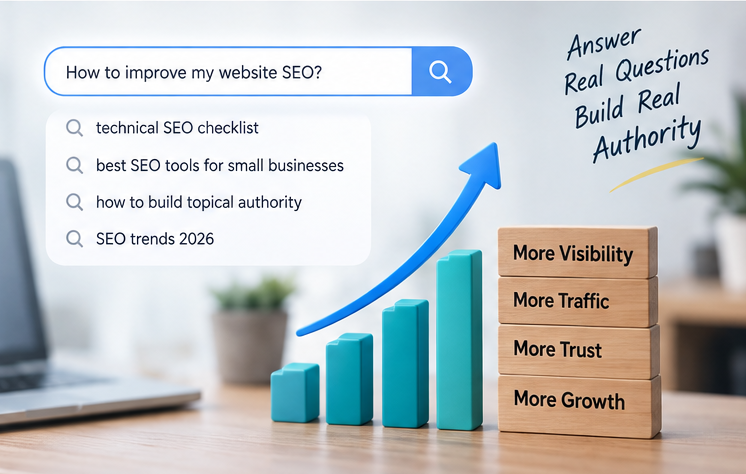
For example, someone interested in SEO may search for:
- “how to improve website SEO”
- “technical SEO checklist”
- “how to fix indexing problems”
- “SEO strategy for small businesses”
- “how internal linking works”
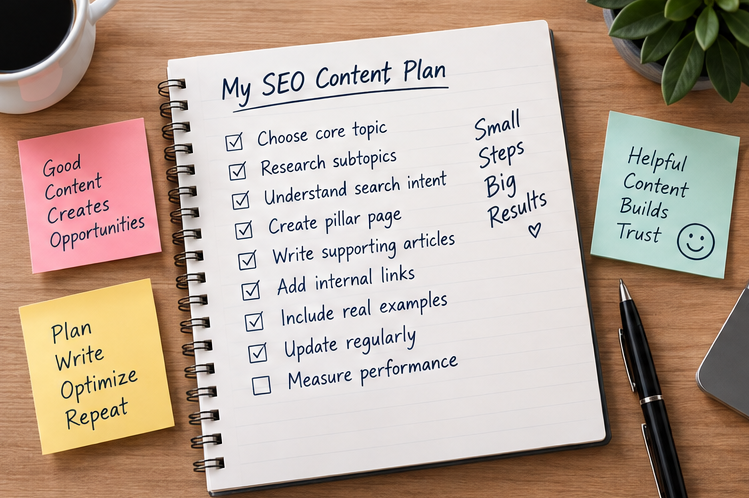
Creating content around relevant long-tail queries can help your website reach users at different stages of their search journey.
3. Improve Internal Linking
A well-planned topic cluster naturally creates opportunities to connect related pages.
For example:
SEO Guide → Keyword Research → On-Page SEO → Technical SEO → Link Building
These connections help users discover additional information while creating a clearer structure for search engines.
4. Improve User Experience
Visitors shouldn’t have to search across multiple websites to understand a subject.
A comprehensive content library allows users to move from beginner-level information to more advanced topics within the same website.
5. Create Long-Term Organic Growth
Individual rankings can fluctuate. A website with a strong content ecosystem, however, has multiple pages targeting related search intents.
This creates more opportunities to attract relevant organic traffic over time.
How to Build Topical Authority in 2026
Building topical authority isn’t about publishing as many articles as possible. It’s about creating the right content in the right structure.
Here’s a practical approach.
Step 1: Choose Your Core Topic
Start with a subject closely connected to your business, products, or services.
For example, a digital marketing agency could focus on:
- SEO
- Digital marketing
- Social media marketing
- Web development
- Content marketing
- PPC advertising
- Branding
Avoid trying to become an authority on everything.
A focused content strategy is easier to manage and gives your website a clearer subject identity.
Step 2: Create a Topic Map
Once you select your main topic, break it into smaller subtopics.
For example, your primary topic could be SEO.
Your topic map might look like this:
SEO
→ Keyword Research
→ On-Page SEO
→ Technical SEO
→ Off-Page SEO
→ Local SEO
→ E-commerce SEO
→ SEO Analytics
→ Content SEO
→ SEO Tools
→ SEO Trends
Each category can then be divided into even more specific questions.
This creates the foundation of your content strategy.
Step 3: Identify Search Intent
Keywords alone don’t tell the entire story.
You need to understand why someone is searching.
Search intent generally falls into several categories:
Informational Intent
The user wants to learn something.
Example:
“What is technical SEO?”
Navigational Intent
The user wants to find a particular website or page.
Example:
“Google Search Console login”
Commercial Investigation
The user is researching options before making a decision.
Example:
“best SEO tools for small businesses”
Transactional Intent
The user is ready to take action.
Example:
“hire SEO agency”
Your content should match the intent behind the query rather than simply repeating the keyword.
Step 4: Build Pillar Pages and Supporting Content
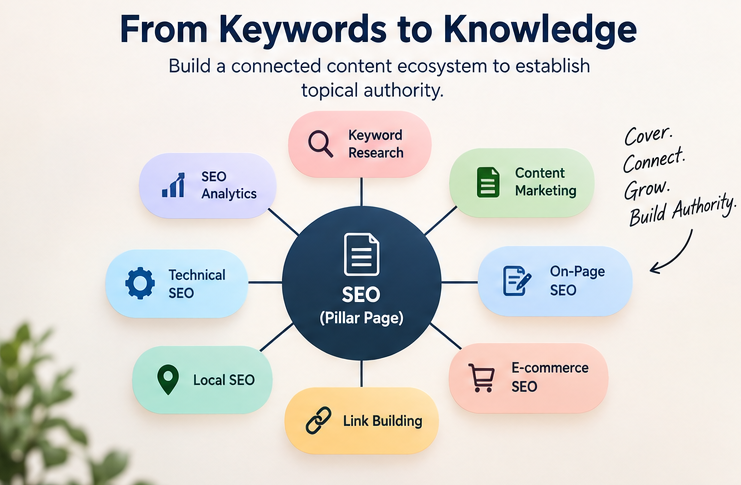
One of the most effective structures for topical authority is the pillar-and-cluster model.
A pillar page provides a comprehensive overview of a broad topic.
Supporting articles explore specific subtopics in greater detail.
For example:
Pillar:
Complete Guide to SEO
Supporting articles:
- Keyword Research Guide
- On-Page SEO Guide
- Technical SEO Checklist
- Internal Linking Guide
- Link Building Strategies
- Local SEO Guide
- SEO Analytics Guide
Each supporting article can link back to the pillar page, while the pillar page links to relevant supporting resources.
This creates a connected content network.
Step 5: Create Content That Actually Satisfies the Query
Publishing content simply because a keyword has search volume is a weak strategy.
Before writing an article, ask:
- What question is the user trying to answer?
- What information do competing pages provide?
- What information is missing?
- Can we explain the subject more clearly?
- Can we provide original examples?
- Can we provide practical steps?
- What would make the reader trust this content?
The objective should be helpfulness first, optimization second.
Step 6: Demonstrate First-Hand Knowledge
In 2026, generic content is increasingly easy to produce.
That makes first-hand experience even more valuable.
Instead of writing:
“Website speed is important for SEO.”
A stronger article could explain:
“During a website optimization project, reducing oversized images and removing unnecessary scripts helped improve page loading performance.”
Real examples, screenshots, original research, case studies, expert insights, and practical observations can make content more useful and credible.
Step 7: Strengthen Internal Linking
Internal links are an important part of a topical content strategy.
When publishing a new article, look for relevant older pages that can link to it.
For example, an article about technical SEO could link to:
- Website indexing
- XML sitemaps
- Robots.txt
- Core Web Vitals
- Canonical URLs
- Website speed
Avoid adding internal links randomly.
Each link should help users navigate to relevant information.
Step 8: Keep Your Content Fresh
Topical authority isn’t something you build once and forget.
Information changes.
SEO practices, search features, technologies, tools, and user behavior continue to evolve.
Review important content regularly and update:
- Outdated statistics
- Screenshots
- Examples
- Links
- SEO recommendations
- Product information
- Industry developments
Don’t update an article merely to change its publication date. Improve the actual content.
Step 9: Build Trust and Expertise
A website should make it clear who is behind its content.
Depending on the type of website, useful trust signals can include:
- Author information
- Author bios
- About Us pages
- Contact information
- Case studies
- Original research
- References and sources
- Client results
- Industry experience
For businesses, combining useful content with transparent information about the company can help create a stronger overall online presence.
Topical Authority vs. Keyword-Driven SEO
Traditional SEO often focuses heavily on individual keywords.
For example:
Keyword:
“SEO agency Pune”
A keyword-driven strategy may create one page specifically targeting that phrase.
A topical strategy asks a broader question:
What information would someone researching SEO services actually need?
That could include:
- What does an SEO agency do?
- How much does SEO cost?
- How long does SEO take?
- How to choose an SEO agency
- Local SEO services
- Technical SEO services
- SEO reporting
- SEO case studies
- SEO strategies for different industries
The second approach creates a broader information ecosystem around the subject.
How AI Search Changes Content Strategy in 2026
AI-powered search experiences have changed how users discover information.
People increasingly expect search systems to summarize information, compare options, answer follow-up questions, and provide context.
For businesses, this means content should be:
- Clear
- Structured
- Specific
- Factually accurate
- Easy to understand
- Supported by credible information
- Organized around real user questions
Instead of writing content solely for a particular keyword, businesses should aim to become a reliable source of information within their niche.
This doesn’t mean trying to “write for AI.” It means creating genuinely useful content that can be understood and referenced across modern search experiences.
Common Topical Authority Mistakes
Building topical authority takes planning. Several common mistakes can weaken the strategy.
Publishing Too Much Low-Quality Content
More content doesn’t automatically mean more authority.
Ten genuinely useful articles can be more valuable than fifty thin articles.
Targeting Unrelated Topics
If a website sells web development services but suddenly publishes articles about unrelated subjects simply because they have high search volume, the overall content strategy becomes unfocused.
Ignoring Search Intent
An article can rank for a keyword and still fail to satisfy visitors.
Always understand what the searcher expects before creating content.
Creating Duplicate or Cannibalizing Pages
Publishing several articles targeting nearly identical search intent can create unnecessary competition between your own pages.
Before creating a new article, check whether an existing page already covers the same subject.
Forgetting Internal Links
A collection of disconnected articles isn’t a strong topic cluster.
Connect related pages logically so users and search engines can understand the relationship between them.
Focusing Only on Traffic
Traffic is useful, but it isn’t the only measurement that matters.
A page attracting 1,000 visitors who have no interest in your service may be less valuable than a page attracting 100 highly relevant prospects.
A Practical Topical Authority Framework
Businesses can use the following framework to build their content strategy:
1. Define the core topic
↓
2. Research subtopics
↓
3. Analyze search intent
↓
4. Create pillar content
↓
5. Build supporting articles
↓
6. Connect content with internal links
↓
7. Add original insights and expertise
↓
8. Measure performance
↓
9. Update and expand the content ecosystem
This process should be repeated continuously.
Measuring Topical Authority
There isn’t a single universal metric called “topical authority” that you can simply check in Google Analytics.
Instead, evaluate multiple indicators, such as:
- Organic impressions
- Organic clicks
- Rankings across related queries
- Number of indexed pages
- Growth in non-branded search traffic
- Internal link coverage
- Engagement metrics
- Conversions from organic traffic
- Backlinks and referring domains
- Visibility across relevant search results
Look at the overall trend rather than judging the strategy based on one keyword.
The Future of SEO Is About Depth, Not Just Volume
SEO in 2026 is increasingly about understanding topics rather than chasing individual keywords.
A successful content strategy should answer an important question:
“Why should someone trust this website as a source of information about this subject?”
The answer comes from consistently publishing useful content, covering relevant subtopics, demonstrating real expertise, creating logical connections between pages, and keeping information accurate and up to date.
Topical authority doesn’t happen overnight.
It is built article by article, link by link, and improvement by improvement.
For businesses that want sustainable organic visibility, the goal shouldn’t simply be to publish more content. The goal should be to build a website that becomes a valuable resource within its industry.
Build a Stronger SEO Content Strategy with The Vanilla Theory
At The Vanilla Theory, we combine SEO, content strategy, web development, and digital marketing to help businesses strengthen their online presence.
From keyword research and content planning to on-page optimization, technical SEO, and website development, a well-connected strategy can help your brand build visibility and attract the right audience.
Ready to build your brand’s topical authority? Start with a content strategy designed around your audience, your expertise, and your business goals.


